
- 주제별 국가전략 목록으로 이동
- 주제별 국가전략
- 전체
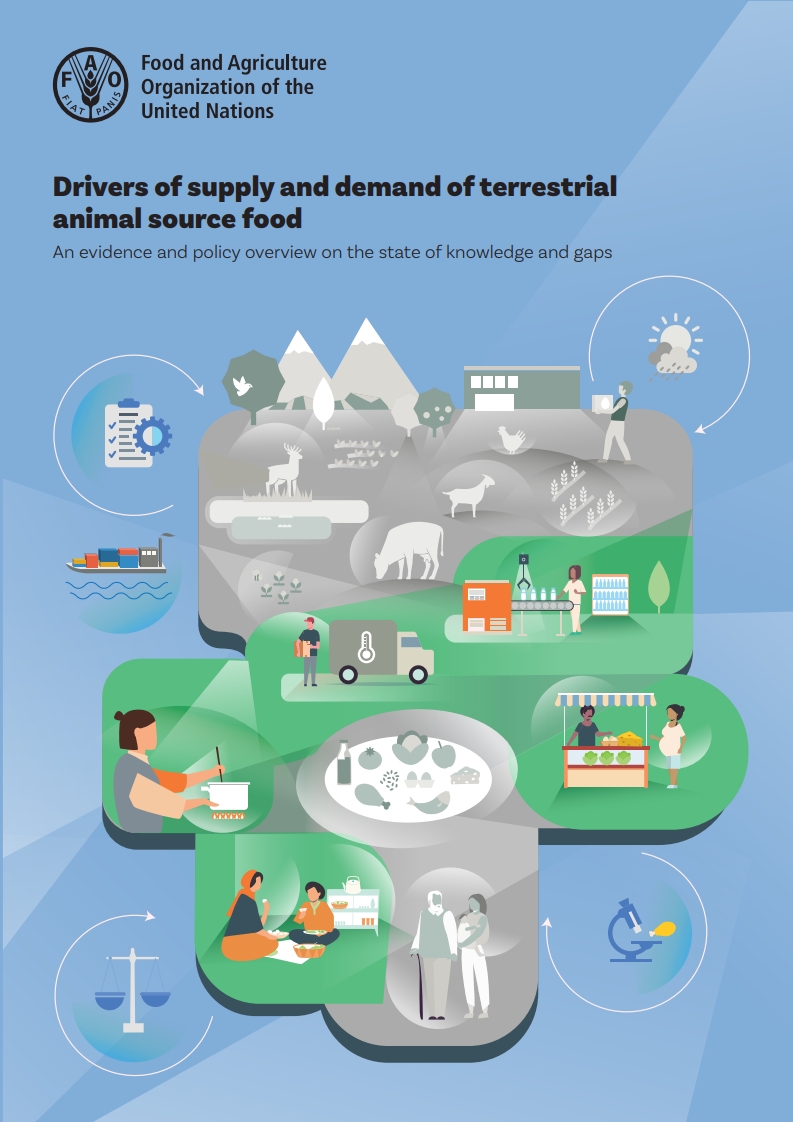
Drivers of supply and demand of terrestrial animal source food: An evidence and policy overview on the state of knowledge and gaps
(육상 동물성 식품의 공급과 수요 동인: 지식 현황 및 격차에 대한 증거와 정책 개요)목차
Foreword vii
Acknowledgements viii
Abbreviations x
Key findings xi
Setting the scene xv
Structure of this document xix
Summary xx
Section A THE FOOD ENVIRONMENT 1
Key concepts 2
Summary 2
1.Conceptual framework describing food environments 5
2.Typologies of food environments 6
3.The status of evidence on food environments 7
References 8
Section B TRENDS IN SUPPLY AND DEMAND 11
Key findings 12
Summary 12
1.Data sources and methods 15
2.Global production and supply 16
3.Regional supply considerations 19
4.Loss and waste of terrestrial animal source food 25
5.Global and regional trade 27
6.Cost and affordability 36
7.Foresight and emerging challenges 40
8.Evidence gaps and research needs 46
References 47
Section C A REVIEW OF THE EVIDENCE 51
Key findings 52
Key gaps in the evidence 53
Summary 53
1.Methods and concepts 55
2.Assessment of evidence on the food environment 61
2.1 Availability 65
2.1.1 Evidence from Northern American food environments 67
2.1.2 Evidence from low- and middle-income countries 70
2.1.3 The role of small-scale livestock production in improving nutrition 71
2.2 Vendor and product properties 76
2.2.1 Evidence from high-income countries 77
2.2.2 Evidence from low- and middle-income countries 77
2.3 Food safety 78
2.4 Marketing and regulation 81
2.4.1 Evidence from high-income countries 82
2.4.2 Evidence from low- and middle-income countries 83
2.5 Price 84
2.5.1 Evidence from high-income countries 84
2.5.2 Evidence from low- and middle-income countries 85
2.6 Accessibility 85
2.7 Affordability 87
2.7.1 Evidence from high-income countries 88
2.7.2 Evidence from low- and middle-income countries 89
2.8 Convenience 94
2.9 Desirability 95
2.9.1 Evidence from high-income countries 96
2.9.2 Evidence from low- and middle-income countries 98
3.Evidence gaps and research needs 101
References 103
Section C A REVIEW OF POLICY AND LEGISLATIVE DOCUMENTS RELATED TO FOOD ENVIRONMENTS 121
Key findings 122
Nexus of evidence from research and policy 122
Summary 123
1.Methods and data 125
2.Assessment of policy and legislative documents 127
2.1 Classification of policy and legislative documents by theme 130
2.2 Food environment dimensions featured in policy and legislative documents 137
2.3 The contributions of terrestrial animal source food to school feeding programmes 140
3.The nexus of evidence from the research and policy spheres 143
4.Current gaps and future areas of focus 147
References 148
GLOSSARY 156
References 165
BOXES
1.What is terrestrial animal source food? xvi
2.Food groups and subgroups related to terrestrial animal source food xvii
A1. Food environment typologies 6
B1. Consumption of insects - a cultural preference in some geographic regions 24
B2. Terrestrial animal source food in Uruguay's National Strategy for the Prevention and Reduction of Food Loss and Waste 26
B3. Trade of live animals 29
B4. Export of lower-value meat cuts from the European Union to Western Africa: trends and potential trade-offs 35
B5. Cell-cultured meat: market potential and consumer perspectives 45
C1. Search string strategy: Web of Science, Medline via Web of Science and EconLit via EBSCOhost 56
C2. Glossary of research methods used in this scoping review 60
C3. Retail shop typology and fat content for milk and meat used in studies featuring Northern American food environments 65
C4. Supporting indigenous honey-hunting communities 76
C5. Milk dispensaries in Kenya 80
C6. The role of social media in sales of meat from wild animals 81
D1. School feeding programmes in Ethiopia 141
D2. The role of terrestrial animal source food in school meals in India 142
해시태그
관련자료


AI 요약·번역·분석 서비스
AI를 활용한 보고서 요약·번역과 실시간 질의응답 서비스입니다.
Drivers of supply and demand of terrestrial animal source food: An evidence and policy overview on the state of knowledge and gaps
(육상 동물성 식품의 공급과 수요 동인: 지식 현황 및 격차에 대한 증거와 정책 개요)
국가전략포털에서 실시간 AI 질의응답 서비스를 시작합니다. 4가지 유형의 요약과 번역을 이용해보시고, 보고서에 대해 추가로 알고 싶은 내용이 있으면 채팅창을 통해 자유롭게 AI에게 물어볼 수 있습니다.
※ 제공하는 정보는 참고용이며, 정확한 사실 확인이 필요할 수 있습니다. 민감한 개인정보는 입력하지 마십시오.