
- 국가전략보고서 목록으로 이동
- 주요국 국가전략
- 전체
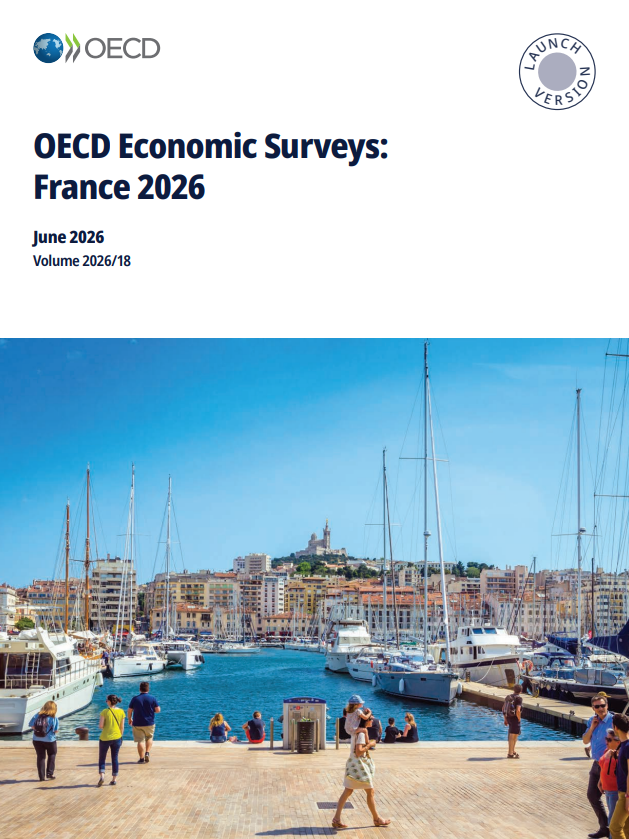
OECD economic surveys : France. 2026
(OECD 경제 동향: 2026년 프랑스)
목차
Title page 1
Contents 5
Foreword 4
Basic statistics of France, 2025 8
Executive summary 9
1. Putting public finances on a sustainable path while boosting long-term growth 18
1.1. Economic activity is set to remain subdued amid heightened uncertainty 19
1.1.1. Policy uncertainty has dampened growth, despite some resilience 19
1.1.2. Risks in the banking sector appear limited but require ongoing vigilance 20
1.1.3. Corporate debt, and to a lesser extent household debt, must also be monitored 21
1.1.4. France has recently regained export market share, but risks weigh on competitiveness 22
1.1.5. Economic growth is set to slow 23
1.2. Putting public finances on a sustainable path 25
1.2.1. The fiscal balance has been structurally in deficit for two decades 26
1.2.2. Significant fiscal consolidation and sequencing are needed to stabilise debt 28
1.2.3. Stabilising debt will primarily depend on controlling spending 30
1.2.4. Ageing-related spending pressures raise financial stability and fairness issues 31
1.2.5. Stronger targeting and efficiency will support spending reductions 34
1.2.6. Optimising the tax system to support revenues and inclusive growth 38
1.3. Raising productivity, employment and medium-term economic growth 43
1.3.1. Boosting productivity to support rising living standards 44
1.3.2. Supporting employment growth, especially for younger and older workers 45
1.3.3. Enhancing the anti-corruption framework 47
References 50
2. Ensuring quality and efficient long-term care 56
2.1. Challenges in meeting long-term care needs are set to increase 57
2.2. Enhancing the quality of long-term care while limiting fiscal pressures 59
2.2.1. Increasing the comprehensiveness of long-term care needs assessments 59
2.2.2. Ensuring equal access to long-term care across the country 61
2.2.3. Increasing the attractiveness of the care and nursing professions 62
2.2.4. Refining support for informal carers 64
2.3. Boosting the efficiency and financing increases in long-term care spending 65
2.3.1. Increasing the targeting of public support for long-term care 65
2.3.2. Limiting rising costs though healthy ageing and greater preventive care 68
2.3.3. Reinforcing the capacity to monitor spending 71
2.3.4. Increasing sources of funding 72
References 74
3. Supporting climate change mitigation and adaptation 78
3.1. Meeting mitigation and adaptation goals 79
3.2. Accelerating emission reductions to remain on track to net-zero goals 80
3.2.1. Boosting the effectiveness and predictability of climate policies 80
3.2.2. Efficiently meeting green investment needs 81
3.2.3. Increasing price incentives to reduce emissions while raising revenues 82
3.2.4. Supporting climate change goals in the transport and residential sectors 83
3.3. Strengthening resilience and adapting to climate-related risks 86
3.3.1. Climate-related risks are varied and increasing, raising public and private costs 86
3.3.2. Defining public adaptation support and better incentivising private resilience 88
3.3.3. Increasing the sustainability of the state-backed natural catastrophe regime, limiting state exposure and increasing incentives... 89
3.3.4. Adapting supervisory toolkits to climate and environmental risks 91
3.3.5. Supporting local authorities to develop adaptation plans 92
3.3.6. Adapting housing to heatwaves, weakening foundations and floods 92
3.3.7. Increasing the resilience of forests and reinforcing carbon sinks 93
References 95
4. Strengthening industrial competitiveness 100
4.1. Addressing economic and strategic risks has revived industrial policy 101
4.2. Industrial policy challenges: strengthening resilience and competitiveness 101
4.2.1. Responding to industrial policy challenges: rationale for policy action 101
4.2.2. France's industrial competitiveness has declined 103
4.2.3. Non-cost factors explain France's loss in export market shares 106
4.3. Rethinking policies to support industrial cost competitiveness 110
4.3.1. Social security contribution reductions - a cornerstone of French industrial policy - have had limited effects 110
4.3.2. Pursuing efforts to reduce production taxes 111
4.3.3. Helping industrial companies with rising energy prices 112
4.3.4. Stimulating competition in business services and simplifying administrative procedures for factory permits 113
4.4. Strengthening the effectiveness of policies supporting industrial innovation 114
4.4.1. Redirecting tax support measures for R&D 114
4.4.2. Maximising the economic impact of direct support to industrial innovation 115
4.4.3. Removing barriers to financing disruptive innovation and intangible assets 117
4.4.4. Providing a competitive environment conducive to industrial dynamism 121
4.5. Strengthening economic resilience 121
4.5.1. Increasing the resilience of the industrial base to shocks in value chains 121
4.5.2. Consolidating strengths in artificial intelligence 123
4.5.3. Preserving industrial competitiveness during the green transition 125
4.6. Maximising the value of human capital 126
4.6.1. Better integrating PhD graduates into the corporate sector 126
4.6.2. Attracting highly skilled labour 127
4.6.3. Using management to improve productivity and industrial competitiveness 128
4.6.4. Improving adult skills to better manage industrial transitions 129
4.6.5. Improving the quality of career guidance in schools 131
References 135
Table 1. Growth is projected to recover modestly 10
Table 1.1. Macroeconomic indicators and projections 24
Table 1.2. Events that could lead to major changes in the outlook 25
Table 1.3. Key fiscal indicators 26
Table 1.4. Illustrative fiscal impacts of OECD-recommended reforms 29
Table 1.5. Tax expenditures are high 39
Table 1.6. Past OECD recommendations on improving fiscal sustainability 43
Table 1.7. Illustrative impact of selected structural reforms on the level of GDP 46
Table 1.8. Policy recommendations 49
Table 2.1. The comprehensiveness of France's LTC needs assessment is ranked medium 60
Table 2.2. France is one of two thirds of OECD countries with a decentralised LTC system 61
Table 2.3. Main findings and recommendations to ensure quality and efficient long-term care 73
Table 3.1. Past OECD recommendations to support the green transition 81
Table 3.2. Main findings and recommendations to support climate change mitigation and adaptation 94
Table 4.1. Past OECD recommendations for improving innovation and education systems 133
Table 4.2. Main findings and recommendations to strengthen competitiveness 134
Figure 1. GDP per capita growth lags behind that in the highest-income economies 11
Figure 2. Debt has continued to increase to record highs 12
Figure 3. For older people with severe needs, out-of-pocket costs can reach the median income 13
Figure 4. Advancing adaptation measures would reduce the costs of climate change 14
Figure 5. Private sector innovation remains subdued 15
Figure 1.1. GDP growth has slowed on the back of heightened uncertainty 19
Figure 1.2. Real wages are picking up and the labour market is softening 20
Figure 1.3. The financial system appears robust 21
Figure 1.4. Corporate debt is elevated, although bankruptcies appear to be stabilising 22
Figure 1.5. Direct exposure to the US market is moderate 23
Figure 1.6. The cost of debt is rising 25
Figure 1.7. France's fiscal deficit has widened over years 27
Figure 1.8. Sizeable fiscal consolidation is required to stabilise debt 28
Figure 1.9. Public spending is high across categories 30
Figure 1.10. Financing ageing costs poses growing intergenerational imbalances 33
Figure 1.11. Health spending by the state and compulsory schemes is high 34
Figure 1.12. France outspends high performers on upper-secondary and tertiary students 36
Figure 1.13. Taxes are high, skewed towards labour, while corporate taxes are around average 39
Figure 1.14. Effective corporate tax is relatively low and financial wealth has increased 42
Figure 1.15. GDP per capita growth lags behind that in the highest-income economies 44
Figure 1.16. Productivity and employment rates lag below those in peer economies 45
Figure 1.17. The fight against corruption and money laundering must continue 48
Figure 2.1. Over one in four people will be over the age of 65 by 2035 57
Figure 2.2. Most care recipients rely at least partly on informal carers, who are slightly more often women 64
Figure 2.3. Public support for home care covers a higher share of low needs than severe needs 66
Figure 2.4. Out-of-pocket costs for home care can exceed older people's incomes 67
Figure 2.5. Out-of-pocket costs in residential LTC institutions vary across income levels 68
Figure 2.6. Healthy ageing can extend healthy life expectancy and delay and reduce LTC needs 69
Figure 2.7. Spending on prevention is low across OECD countries and in France 71
Figure 3.1. Greenhouse gas emission reductions must accelerate 79
Figure 3.2. France's climate action has increased 80
Figure 3.3. Carbon prices differ significantly across economic sectors and energy sources 83
Figure 3.4. The share of electric vehicles is growing, but lags behind some OECD countries 84
Figure 3.5. France is exposed to rising temperatures and risks of flooding 86
Figure 3.6. Adaptation measures are essential to reduce the costs of climate-related damages 87
Figure 3.7. Inaction against climate change would lower productivity 87
Figure 3.8. Insurance coverage against natural hazards is above the OECD average 90
Figure 4.1. A marked decline in industry and external performance 104
Figure 4.2. Breakdown of the main factors contributing to deindustrialisation 105
Figure 4.3. Cost competitiveness is not France's main problem 106
Figure 4.4. The growth potential of intangible assets remains underutilised 107
Figure 4.5. The accumulation of digital capital is slower than in the best-performing countries 108
Figure 4.6. Start-ups are struggling to scale-up 109
Figure 4.7. Firms face skills shortages 109
Figure 4.8. Contained labour costs are supported by policies reducing social security contributions 111
Figure 4.9. Production taxes are relatively high but electricity costs relatively low 112
Figure 4.10. A favourable competitive environment with room for improvement and risks related to market concentration 113
Figure 4.11. The effectiveness of the research tax credit in raising business R&D is limited 114
Figure 4.12. Direct support for innovation is strong, but could be more focussed on emerging technologies 116
Figure 4.13. Venture capital, while dynamic, remains insufficient, and bank guarantees are not particularly focused on growth sectors 120
Figure 4.14. There is high exposure to value chain shocks and restrictions on digital services trade limit firms' agility 123
Figure 4.15. France is a leader in AI ecosystems but AI investment continues to lag 124
Figure 4.16. High risks of carbon leakage are partly mitigated by the carbon border adjustment mechanism 125
Figure 4.17. PhD holders are not very present in the private sector, and France's appeal for highly skilled workers is limited 128
Figure 4.18. Vertical management is an obstacle to performance 129
Figure 4.19. Skills gaps among adults are holding back growth, and lifelong learning programmes remain partially inadequate 130
Figure 4.20. Labour market shortages in industry remain high, and weaknesses in the education system are weighing on productivity 132
Boxes 7
Box 1.1. Potential impact on growth of the OECD recommended reforms 46
Box 2.1. Long-term care services in France: definition, public measures, and financing 58
Box 3.1. The main public funds financing adaptation 89
Box 4.1. Industrial policies: a brief overview of economic justifications and the intervention framework 102
Box 4.2. Analysis of structural change: an accounting approach 105
Box 4.3. International examples of public support schemes for business angels 119
해시태그
관련자료



AI 요약·번역·분석 서비스
AI를 활용한 보고서 요약·번역과 실시간 질의응답 서비스입니다.
OECD economic surveys : France. 2026
(OECD 경제 동향: 2026년 프랑스)
국가전략포털에서 실시간 AI 질의응답 서비스를 시작합니다. 4가지 유형의 요약과 번역을 이용해보시고, 보고서에 대해 추가로 알고 싶은 내용이 있으면 채팅창을 통해 자유롭게 AI에게 물어볼 수 있습니다.
※ 제공하는 정보는 참고용이며, 정확한 사실 확인이 필요할 수 있습니다. 민감한 개인정보는 입력하지 마십시오.