



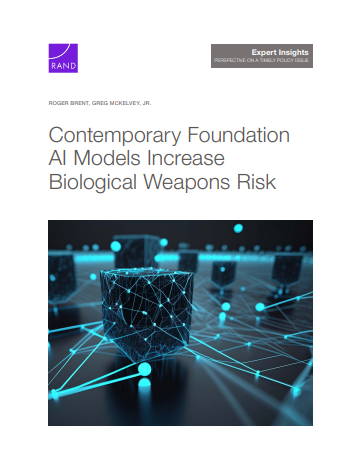
목차
About This Paper iii
Summary v
Figures Tables and Boxes ix
CHAPTER 1
Introduction 1
Current AI Safety Assessments Underestimate Biological Weapons Risk 1
How We Organize This Paper 2
Assumptions 3
CHAPTER 2
Possible Shortcomings in Assessments of AI Biological Weapons Risk 5
Role of Benchmarks in AI Safety Assessments 5
Importance of Tacit Knowledge in AI Risk Assessments 6
Countering the Value of Tacit Knowledge 8
Additional Shortcomings in AI Risk Assessments 8
CHAPTER 3
Chemical Synthesis of Explosive Compounds by a Nonexpert 13
Understanding Breivik’s Motivations 13
Accomplishing Technical Tasks Without Expertise 14
CHAPTER 4
Identifying Elements of Technical Success to Inform New AI Safety Benchmarks 17
Identifying Key Tasks and Subtasks for Building and Recovering a Pathogenic Virus 17
Identifying Capabilities Concepts and Activities for Goal Directed Technical Development 18
Identifying Elements of Success 21
Availability of Benchmarks for Evaluating AI Models’ Ability to Articulate the Different Elements of
Success 21
CHAPTER 5
Testing Foundation AI Models’ Ability to Guide Biological Weapons Development 25
Testing the Ability of AI Foundation Models to Assist Live Poliovirus Recovery 26
Contemporary Frontier AI Models Provide Guidance to Repeat the 2002 Work 28
CHAPTER 6
Discussion 35
Challenging AI Developers’ Assessments of Biological Weapons Risk 35
Additional Factors Contributing to Models’ Biological Weapons Risk 38
Too Late for Better Benchmarks 40
Proposed Hypotheses for Further Assessment of AI Models’ Biological Weapons Risk 40
Key Developments in Foundation AI Capability During 2025 41
What Is to Be Done 41
Conclusion 42
Abbreviations 43
References 45
About the Authors 49
해시태그
관련자료


AI 100자 요약·번역서비스
인공지능이 자동으로 요약·번역한 내용입니다.