
- 주제별 국가전략 목록으로 이동
- 주제별 국가전략
- 전체
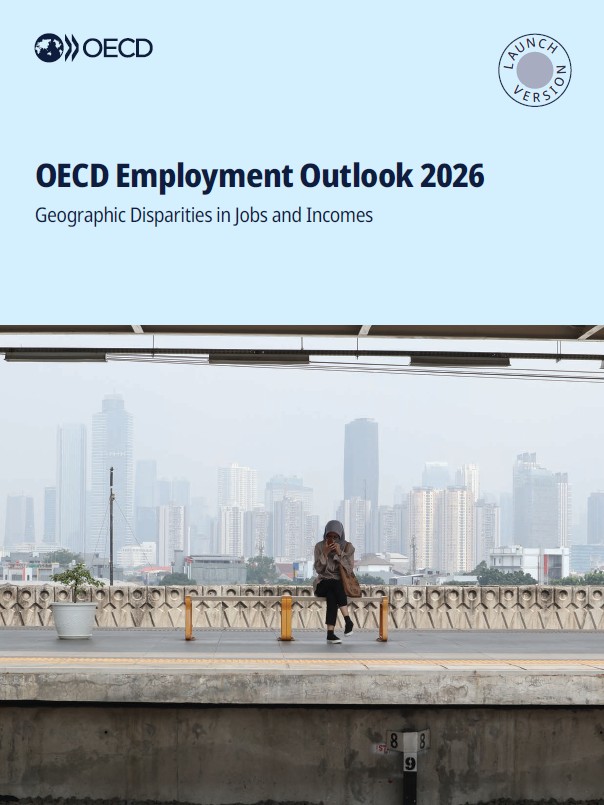
OECD Employment Outlook 2026
(OECD 고용전망 2026: 지역 간 노동시장 격차와 임금 압박)목차
Table of contents
Foreword 3
Editorial: People to jobs and jobs to people: Reducing regional disparities in the labour market 5
Executive summary 15
1 From resilience to risk: Employment and wages under pressure 18
In Brief 19
Introduction 20
1.1. Labour markets have remained resilient but there have been further signs of weakening 20
1.2. The real wage recovery was already slowing down before the recent surge in energy prices 34
1.3. Young labour market entrants face particular labour market difficulties 54
1.4. Concluding remarks 59
References 60
Annex 1.A. Additional results 64
Notes 78
2 Workers, households, regions: Geographic disparities in labour market outcomes and the distribution of income 82
In Brief 83
Introduction 84
2.1. Regional disparities in labour market outcomes 87
2.2. From labour market outcomes to the distribution of household incomes: Regional
inequalities in living standards 104
2.3. Moving up the ladder: Regional disparities in people’s income mobility 121
2.4. Concluding remarks 124
References 125
Annex 2.A. Sources of data on regional labour market outcomes 134
Annex 2.B. Sources of data on regional income distributions 136
Annex 2.C. Sources of data on regional income mobility 141
Annex 2.D. Regions excluded from the analysis 142
Annex 2.E. Additional results 147
Notes 151
3 Places and people: The impact of structural change on local labour markets 153
In Brief 154
Introduction 156
3.1. Regional specialisation and regional exposure to structural change 157
3.2. The impact of structural change on places, people and firms 167
3.3. Implications for place-based and national policies 182
3.4. Concluding remarks 189
References 190
Annex 3.A. Data sources 196
Annex 3.B. Additional results 197
Notes 199
4 Skills at work: New evidence on returns to skills and training 202
In Brief 203
Introduction 205
4.1. Skills play a key role in shaping labour market outcomes beyond formal education 207
4.2. Training and learning are associated with positive labour market outcomes, particularly in
the case of non-formal training 217
4.3. Fostering skills development and high-return training requires renewed public policies 228
4.4. Concluding remarks 231
References 232
Annex 4.A. Methodological annex 239
Annex 4.B. Robustness checks 240
Notes 243
5 Non-compete and related agreements: Hoarding talent, holding back growth? 244
In Brief 245
Introduction 247
5.1. The economics of non-compete and related clauses 248
5.2. How do OECD countries regulate non-compete clauses? 252
5.3. The incidence and characteristics of non-compete clauses 256
5.4. Non-compete clauses, wages and productivity 276
5.5. Policy discussion 289
5.6. Concluding remarks 292
References 293
Annex 5.A. Survey specifications 300
Annex 5.B. Additional figures and tables 309
Notes 318
6 Recent trends in employment protection legislation: Tackling dualism by harmonising and strengthening regulations 325
In Brief 326
Introduction 327
6.1. Tailored EPL can help labour markets navigate short-term fluctuations and structural
changes in a fair and effective manner 328
6.2. Dismissal regulation for workers on open-ended contracts 331
6.3. Regulation of temporary contracts 339
6.4. Recent reforms in EPL: Harmonising protection of workers on open-ended contracts and strengthening regulation of temporary contracts 347
6.5. Concluding remarks 356
References 357
Annex 6.A. Additional material 363
Notes 376
Annex A. Statistical annex 383
해시태그
관련자료



AI 요약·번역·분석 서비스
AI를 활용한 보고서 요약·번역과 실시간 질의응답 서비스입니다.
OECD Employment Outlook 2026
(OECD 고용전망 2026: 지역 간 노동시장 격차와 임금 압박)
국가전략포털에서 실시간 AI 질의응답 서비스를 시작합니다. 4가지 유형의 요약과 번역을 이용해보시고, 보고서에 대해 추가로 알고 싶은 내용이 있으면 채팅창을 통해 자유롭게 AI에게 물어볼 수 있습니다.
※ 제공하는 정보는 참고용이며, 정확한 사실 확인이 필요할 수 있습니다. 민감한 개인정보는 입력하지 마십시오.