
- 주제별 국가전략 목록으로 이동
- 주제별 국가전략
- 전체
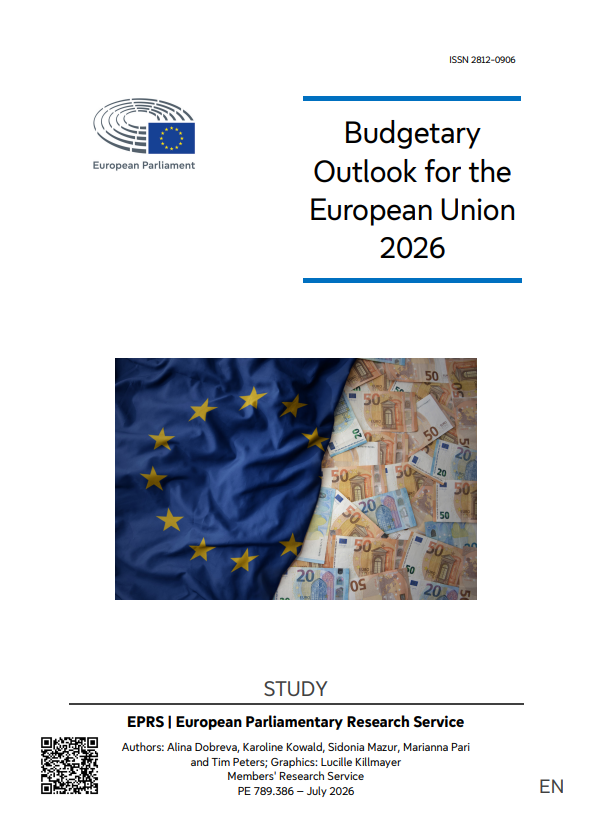
Budgetary Outlook for the European Union 2026
(2026년 유럽연합(EU) 예산 전망)목차
1. Foreword 1
2. EU budget: Structure and principles 3
2.1. Role and size of the EU budget 3
2.2. EU budget structure 7
2.2.1. Revenues 7
2.2.2. Expenditure – Multiannual planning and annual budget 8
2.3. Main institutional actors in three key phases of the budgetary cycle – Budgetary powers explained 10
2.3.1. Adoption 10
2.3.2. Implementation 11
2.3.3. Scrutiny of EU spending 11
3. EU multiannual financial framework 13
3.1. EU budget resources 13
3.2. 2021-2027 multiannual financial framework 15
3.2.1. Ceilings for commitments and payments 15
3.2.2. Revision of the 2021-2027 MFF Regulation 17
3.3. EU budget flexibility and special instruments 19
3.3.1. Margins under the MFF ceilings 19
3.3.2. Special instruments 20
3.3.3. Next Generation EU contribution to the EU budget and repayment cost 23
3.3.4. Support to Ukraine 26
3.4. Budgetary challenges ahead 28
3.5. Shaping the 2028-2034 multiannual financial framework 31
3.5.1. European Commission proposal 31
3.5.2. Structure of the proposed 2028-2034 MFF 31
3.5.3. Economic, social and territorial cohesion, agriculture, rural and maritime prosperity and security (Heading 1) 32
3.5.4. Competitiveness, prosperity and security (Heading 2) 33
3.5.5. Global Europe (Heading 3) 33
3.5.6. Administration (Heading 4) 34
3.5.7. Special instruments 34
3.5.8. Measuring the performance of the EU budget 35
3.6. Negotiations on the 2028-2034 MFF 39
3.6.1. Procedure 39
3.6.2. European Parliament deliberations 40
4. EU budget revenues: Reform of the own resources system 43
4.1. Decision-making and implementation of own resources 43
4.2. Existing types of own resource 44
4.2.1. Traditional own resources 45
4.2.2. VAT-based own resources 46
4.2.3. GNI-based own resources 46
4.2.4. Statistical own resource on non-recycled plastic packaging waste 47
4.2.5. Other revenue 47
4.3. New own resources – Preparatory developments 48
4.4. New own resources – State of play of the reform 50
4.5. Debt as a source of revenue 52
4.5.1. Debt and NGEU 52
4.5.2. Debt options in the 2028-2034 MFF proposal 53
4.5.3. Debt-financing EU defence 55
4.6. Other potential sources of revenue for EU policy objectives 55
5. EU budget for 2026 59
5.1. Overview of the adopted 2026 budget 59
5.2. Parliament's position and 2026 budget negotiations 63
5.3. Outlook on the 2027 budget 68
5.4. Annual budgetary procedure in the new MFF proposal 68
6. Implementation of the budget and scrutiny of EU spending: Procedures in the European Parliament 71
6.1. Democratic scrutiny of the EU budget 71
6.2. Main steps in the budgetary discharge procedure 73
6.3. Discharge for RRF spending 74
6.4. Rule of law and the Budgetary Conditionality Regulation – A new tool to protect the EU's financial interests 76
6.5. Reforms in the area of democratic and budgetary scrutiny 79
6.6. Democratic oversight and budgetary scrutiny in the context of the future MFF 80
7. Annexes 82
해시태그
관련자료



AI 요약·번역·분석 서비스
AI를 활용한 보고서 요약·번역과 실시간 질의응답 서비스입니다.
Budgetary Outlook for the European Union 2026
(2026년 유럽연합(EU) 예산 전망)
국가전략포털에서 실시간 AI 질의응답 서비스를 시작합니다. 4가지 유형의 요약과 번역을 이용해보시고, 보고서에 대해 추가로 알고 싶은 내용이 있으면 채팅창을 통해 자유롭게 AI에게 물어볼 수 있습니다.
※ 제공하는 정보는 참고용이며, 정확한 사실 확인이 필요할 수 있습니다. 민감한 개인정보는 입력하지 마십시오.