
- 주제별 국가전략 목록으로 이동
- 주제별 국가전략
- 전체
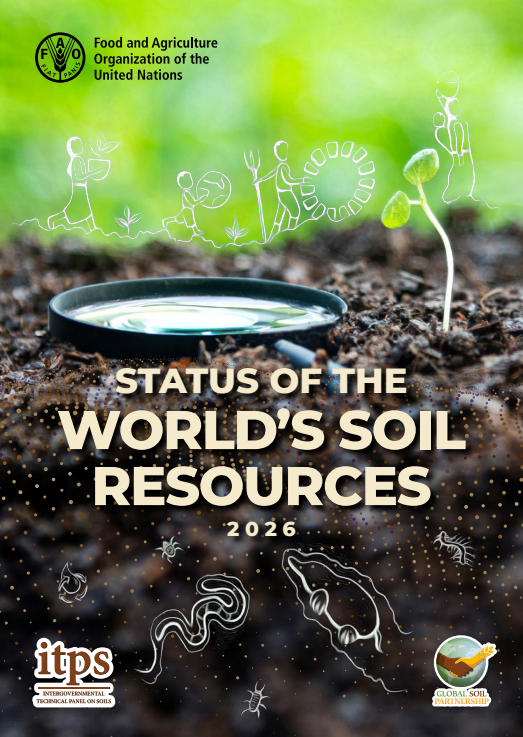
Status of the world's soil resources 2026
(2026년 세계 토양 자원 현황)목차
Contributors XV
Foreword XXII
Acknowledgements XXIV
Abbreviations XXV
Chapter 1 | Introduction 1
1.1 Purpose and approach of the report 1
1.2 Structure of the report 3
References for Chapter 1 4
Chapter 2 | Soils and the Sustainable Development Goals 7
2.1 Introduction 7
2.2 Ecosystem services, nature's contributions to people, and soil functions 8
2.3 Links between soils and specific Sustainable Development Goals 11
2.3.1 Food security and sustainable agriculture (SDG 2: Zero Hunger) 11
2.3.2 Water security and resources (SDG 6: Clean Water and Sanitation) 15
2.3.3 Anthropogenic climate change (SDG 13: Climate Action) 16
2.3.4 Soil pollution and human and ecosystem health 21
2.3.5 Soil biodiversity (SDG 15: Life on Land) 24
2.3.6 Terrestrial ecosystems (SDG 15: Life on Land) 26
2.3.7 SDG 11: Sustainable Cities and Communities 28
2.4 Soils and human societies 29
2.5 Summary 30
References for Chapter 2 31
Chapter 3 | Threats to soil functions 37
3.1 Introduction and scope of chapter 37
3.2 Soil erosion 38
3.2.1 Introduction 38
3.2.2 Thresholds for erosion 38
3.2.3 Water erosion 39
3.2.4 Wind erosion 44
3.2.5 Tillage erosion 47
3.2.6 Shallow landslides 48
3.2.7 Soil loss due to crop harvesting 49
3.3 Soil organic carbon loss 50
3.3.1 Introduction 50
3.3.2 Soil organic carbon loss in mineral soils: Definition and processes responsible for loss 52
3.3.3 Soil organic carbon from wetlands, peatlands and mangrove forests 61
3.3.4 Soil organic carbon loss in permafrost soils 65
3.3.5 Soil inorganic carbon loss 69
3.4 Soil biodiversity change 70
3.4.1 Introduction 70
3.4.2 Global assessments of soil biodiversity 70
3.4.3 Global threats to soil biodiversity 71
3.5 Nutrient mismanagement 76
3.5.1 Overview of nutrient balances 76
3.5.2 Environmental consequences of nutrient excess 79
3.5.3 Nutrient mining and yield gaps 83
3.5.4 Acidification 84
3.6 Salt accumulation 87
3.6.1 Overview of salt accumulation 87
3.6.2 Global distribution of salt-affected soils 88
3.6.3 Drivers of changes in salt accumulation 92
3.7 Soil pollution 94
3.7.1 Introduction 94
3.7.2 Inorganic pollutants 98
3.7.3 Organic pollutants 99
3.7.4 Emerging pollutants 101
3.8 Urban expansion and changes to soil functions 102
3.8.1 Introduction 102
3.8.2 Effects of urbanization on soil functions and ecosystem services 103
3.9 Physical degradation 105
3.9.1 Introduction 105
3.9.2 Soil compaction, hardsetting and workability 105
3.10 Summary 108
3.10.1 Introduction 108
3.10.2 Summary for soil erosion 108
3.10.3 Summary for soil organic carbon loss 109
3.10.4 Soil biodiversity 110
3.10.5 Nutrient mismanagement 110
3.10.6 Salt accumulation 112
3.10.7 Soil pollution 113
3.10.8 Urban expansion and soil sealing 113
3.10.9 Soil compaction 114
References for Chapter 3 115
References for Box 3.1 128
References for Box 3.2 129
Chapter 4 | Direct and indirect drivers of threats to soil functions 131
4.1 Overview of drivers 131
4.2 Indirect drivers 134
4.2.1 Population change 134
4.2.2 Demand for food and wood 136
4.3 Direct drivers 138
4.3.1 Land-use change 138
4.3.2 Changes in agrochemical use 143
4.3.3 Changes in agricultural and forestland management 149
4.3.4 Urban expansion, infrastructure development and extractive industries 152
4.4 Conflict as a driver of soil change 158
4.5 Summary 163
References for Chapter 4 166
Chapter 5 | Sustainable soil management in support of the Sustainable Development Goals 171
5.1 Introduction 171
5.2 Cross-cutting sustainable soil management practices 172
5.2.1 Manure additions 172
5.2.2 Cover crops 173
5.2.3 Residue retention, residue return and mulching 174
5.2.4 Biochar 175
5.2.5 No-till and reduced tillage 176
5.2.6 Improved nutrient management 178
5.2.7 Organic agriculture 183
5.2.8 Agroforestry 184
5.2.9 Regenerative agriculture 184
5.2.10 Conservation agriculture 186
5.3 Sustainable soil management to improve food security and support sustainable food systems (SDG 2 and SDG 11) 187
5.3.1 Introduction 187
5.3.2 Reducing soil erosion caused by water, tillage and crop harvest 187
5.3.3 Reducing nutrient mining 192
5.3.4 Reducing acidification 194
5.3.5 Reducing salt accumulation 195
5.3.6 Reducing loss of agricultural land to urban expansion 197
5.4 Water security and water resources (SDG 6) 199
5.4.1 Introduction 199
5.4.2 Reducing runoff and sedimentation 199
5.4.3 Increasing water-use efficiency in agriculture 201
5.4.4 Reducing agrochemical pollution of water 204
5.5 Human-induced climate change (SDG 13: Climate Action) 205
5.5.1 Introduction 205
5.5.2 Estimates of mitigation potential of soil-based practices 205
5.5.3 Increasing soil organic carbon content 207
5.5.4 Reducing nitrous oxide and methane emissions from soil 210
5.5.5 Reducing carbon dioxide emissions from soil inorganic sources 212
5.6 Soil pollution and human and ecosystem health (SDG 3: Good Health and Well-being) 213
5.6.1 Introduction 213
5.6.2 Reducing soil pollution and remediating polluted sites 213
5.6.3 Reducing ammonia emissions from soils 218
5.7 Halt the loss of soil biodiversity and reduce wind erosion (SDG 15: Life on Land) 219
5.7.1 Introduction 219
5.7.2 Halt the loss of soil biodiversity 219
5.7.3 Reducing loss of wetlands and organic soils 221
5.7.4 Reducing wind erosion 222
5.7.5 Reducing shallow landslides 223
5.8 Summary 225
Conclusion 230
References for Chapter 5 231
Sources for Table 5.6 242
Chapter 6 | Facilitating the adoption of sustainable soil management 245
6.1 Introduction 245
6.2 Traditional and Indigenous Peoples' knowledge 246
6.3 Soil information 248
6.4. Education and public awareness 251
6.5. Economic benefits 253
6.6. Incentives for adoption 255
6.7 Soil governance at a global scale 257
6.8. Conclusions 259
References for Chapter 6 260
Chapter 7 | Criteria for assessment of state, trend and confidence for the regional assessments 265
7.1 Introduction 265
7.2 Development of the criteria for assessment of state and trend 265
7.3 Specific classes used for state and trend 266
7.4 Methodology for regional assessments, graphical summaries and confidence rating 269
7.5 Differences between the 2015 and 2026 Status of the world's soil resources reports 271
References for Chapter 7 273
Chapter 8 | Regional assessment for Asia 275
8.1 Regional overview 276
8.1.1 Characteristics of region and subregions 276
8.2 Changes in drivers of threats to soil functions 282
8.2.1 Population growth 282
8.2.2 Land-use change 282
8.2.3 Nutrient management 287
8.2.4 Climate change 289
8.3. Regional status and trends of threats to soil functions for the East Asia subregion 290
8.3.1 Introduction 290
8.3.2 Soil erosion in the East Asia subregion 290
8.3.3 Loss of soil organic carbon in East Asia subregion 292
8.3.4 Loss of soil biodiversity in East Asia subregion 294
8.3.5 Nutrient mismanagement in East Asia subregion 295
8.3.6 Salt accumulation in East Asia subregion 297
8.3.7 Soil pollution in East Asia subregion 298
8.3.8 Urban expansion and soil sealing in East Asia subregion 299
8.3.9 Other threats in East Asia subregion 302
8.4 Regional status and trends of threats to soil functions for the South Asia subregion 304
8.4.1 Introduction 304
8.4.2 Soil erosion in South Asia subregion 304
8.4.3 Loss of soil organic carbon in South Asia subregion 305
8.4.4 Loss of soil biodiversity in South Asia subregion 306
8.4.5 Nutrient mismanagement in South Asia subregion 306
8.4.6 Salt accumulation in South Asia subregion 307
8.4.7 Soil pollution in South Asia subregion 308
8.5 Regional status and trends of threats to soil functions for the Southeast Asia subregion 310
8.5.1 Introduction 310
8.5.2 Soil erosion in Southeast Asia subregion 314
8.5.3 Loss of soil organic carbon in Southeast Asia subregion 324
8.5.4 Nutrient mismanagement in Southeast Asia subregion 327
8.5.5 Salt accumulation in Southeast Asia subregion 330
8.5.6 Soil acidification in Southeast Asia subregion 332
8.5.7 Urban expansion and soil sealing in Southeast Asia subregion 336
8.5.8 Soil pollution in Southeast Asia subregion 336
8.5.9 Soil water availability 338
8.5.10 Other issues 338
8.6 Trends in sustainable soil management 341
8.6.1 Summary of state and trend in sustainable soil management 341
8.6.2 Progress in and impediments to adoption of sustainable soil management 344
8.6.3 Recommendations for future priorities for action 344
References for Chapter 8 345
Sources for Table 8.19 361
Chapter 9 | Regional assessment for Europe and Central Asia 365
9.1 Regional overview 366
9.1.1 Characteristics of the region 366
9.1.2 Summary of status from the 2015 Status of the world's soil resources report 368
9.2 Changes in the drivers of threats to soil functions 369
9.2.1 Overall population and urban population growth 369
9.2.2 Land-use changes 369
9.2.3 Nutrient management 372
9.3 Regional status and trend of threats to soil functions for Europe and Central Asia 374
9.3.1 Introduction 374
9.3.2 Soil erosion in Europe and Central Asia 378
9.3.3 Loss of soil organic carbon in Europe and Central Asia 382
9.3.4 Loss of soil biodiversity in Europe and Central Asia 388
9.3.5 Nutrient mismanagement in Europe and Central Asia 389
9.3.6 Soil acidification in Europe and Central Asia 393
9.3.7 Soil pollution in Europe and Central Asia 395
9.3.8 Salt accumulation in Europe and Central Asia 400
9.3.9 Soil compaction in Europe and Central Asia 401
9.3.10 Urbanization and soil sealing in Europe and Central Asia 403
9.4 Trends in sustainable soil management in Europe and Central Asia 405
9.4.1 Examples of promising trends in sustainable soil management 405
9.4.2 Impediments to adoption of sustainable soil management 408
9.4.3 Conclusion and recommendations 409
References for Chapter 9 411
References for Table 9.2 421
References for Table 9.4 423
References for Table 9.10 425
Chapter 10 | Regional assessment for Latin America and the Caribbean 429
10.1 Latin America and the Caribbean regional overview 430
10.1.1 Characteristics of region and subregions 430
10.1.2 Status summary from the 2015 Status of the world's soil resources report 436
10.2. Changes in the direct and indirect drivers of threats to soil functions 437
10.2.1 Population growth 437
10.2.2 Land-use change 437
10.2.3 Nutrient management 441
10.3 Regional status and trend of threats to soil functions for Central America, southern Mexico and the Caribbean subregion 446
10.3.1 Soil erosion in the Central America, southern Mexico and the Caribbean subregion 446
10.3.2 Soil carbon loss in the Central America, southern Mexico and the Caribbean subregion 447
10.3.3 Soil biodiversity loss in the Central America, southern Mexico and the Caribbean subregion 448
10.3.4 Nutrient mismanagement in the Central America, southern Mexico and the Caribbean subregion 448
10.3.5 Salt accumulation in the Central America, southern Mexico and the Caribbean subregion 449
10.3.6 Soil moisture change in the Central America, southern Mexico and the Caribbean subregion 450
10.4 Regional status and trend of threats to soil functions for the Amazon subregion 451
10.4.1 Introduction 451
10.4.2 Soil erosion in the Amazon subregion 453
10.4.3 Soil carbon loss in the Amazon subregion 455
10.4.4 Soil biodiversity change 456
10.4.5 Nutrient mismanagement in the Amazon subregion 457
10.4.6 Soil pollution in the Amazon subregion 458
10.4.7 Urbanization and soil sealing in the Amazon subregion 458
10.5 Regional status and trend of threats to soil functions for the Cerrado subregion 459
10.5.1 Soil erosion in the Cerrado subregion 459
10.5.2 Loss of soil organic carbon in the Cerrado subregion 462
10.5.3 Soil biodiversity loss in the Cerrado subregion 465
10.5.4 Nutrient mismanagement in the Cerrado subregion 466
10.5.5 Salt accumulation in the Cerrado subregion 467
10.5.6 Soil pollution in the Cerrado subregion 467
10.5.7 Other threats in the Cerrado subregion 468
10.6 Regional status and trend of threats to soil functions for the Del Plata Basin subregion 469
10.6.1 Soil erosion in the Del Plata subregion 469
10.6.2 Loss of soil carbon in the Del Plata subregion 470
10.6.3 Soil biodiversity loss in the Del Plata subregion 471
10.6.4 Nutrient mismanagement in the Del Plata subregion 472
10.6.5 Salt accumulation in the Del Plata subregion 472
10.6.6 Soil pollution in the Del Plata subregion 473
10.6.7 Urbanization and soil sealing in the Del Plata subregion 473
10.7 Regional status and trend of threats to soil functions for the Andean countries and Patagonia subregion 474
10.7.1 Soil erosion in the Andean countries and Patagonia subregion 474
10.7.2 Soil carbon loss in the Andean countries and Patagonia subregion 475
10.7.3 Soil biodiversity loss in the Andean countries and Patagonia subregion 477
10.7.4 Nutrient mismanagement in the Andean countries and Patagonia subregion 477
10.7.5 Salt accumulation in the Andean countries and Patagonia subregion 477
10.7.6 Soil pollution in the Andean countries and Patagonia subregion 478
10.7.7. Other threats in the Andean countries and Patagonia subregion 479
10.8 Trends in sustainable soil management for the Latin America and Caribbean region 480
References for Chapter 10 486
Chapter 11 | Regional assessment for the Near East and North Africa (NENA) 507
11.1 Regional overview 508
11.1.1 Characteristics of the region 508
11.1.2 Status summary from 2015 Status of the world's soil resources report 511
11.2 Changes in the direct and indirect drivers of soil functions 513
11.2.1 Indirect drivers: population growth 513
11.2.2 Direct drivers: land conversion 513
11.3 Status and trend of threats to soil functions in the Near East and North Africa (NENA) region 520
11.3.1 Soil erosion in the Near East and North Africa region 520
11.3.2 Soil carbon loss in the Near East and North Africa region 527
11.3.3 Soil biodiversity loss in the Near East and North Africa region 530
11.3.4 Nutrient mismanagement in the Near East and North Africa region 532
11.3.5 Salt accumulation in the Near East and North Africa region 538
11.3.6 Soil pollution in the Near East and North Africa region 541
11.4 Trends in sustainable soil management 549
11.4.1 Summary of state of and trend in sustainable soil management 549
11.4.2 Priorities for sustainable soil management 552
References for Chapter 11 554
Chapter 12 | Regional assessment for North America region 565
12.1 Regional overview 565
12.1.1 Characteristics of the region 565
12.1.2 Summary of status and trend from the 2015 Status of the world's soil resources report 567
12.2 Changes in the drivers of threats to soil functions 568
12.2.1 Overall population and urban population growth 568
12.2.2 Land-use change 568
12.2.3 Nutrient management 570
12.3 Regional status and trend of threats to soil functions for North America region 571
12.3.1 Soil erosion in the North America region 571
12.3.2 Nutrient mismanagement in the North America region 581
12.3.3 Ecoregional assessment of soil carbon change in the North America region 593
12.3.4 Soil biodiversity loss in the North America region 602
12.3.5 Urbanization and soil sealing 607
12.4 State and trends in sustainable soil management 613
References for Chapter 12 617
Sources for Figure 12.8 631
Chapter 13 | Regional assessment for the Southwest Pacific region 633
13.1 Regional overview 633
13.1.1 Characteristics of the region and subregions 633
13.1.2 Summary of state from 2015 State of the World's Soil Resources report 639
13.2 Changes in the drivers of threats to soil functions 640
13.2.1 Population growth 640
13.2.2 Land-use changes 641
13.2.3 Nutrient management 645
13.2.4 Other drivers in the Pacific Island countries 646
13.3 Regional status and trend of threats to soil functions for Australia 647
13.3.1 Indigenous Peoples' viewpoint 647
13.3.2 Soil erosion in Australia 647
13.3.3 Soil carbon loss in Australia 650
13.3.4 Soil biodiversity loss in Australia 653
13.3.5 Nutrient mismanagement in Australia 654
13.3.6 Salt accumulation in Australia 657
13.3.7 Soil pollution in Australia 660
13.3.8 Urbanization and soil sealing in Australia 661
13.3.9 Soil governance in Australia 662
13.4 Regional status and trend of threats to soil functions for New Zealand 664
13.4.1 Indigenous Peoples' viewpoint 664
13.4.2 Soil erosion in New Zealand 665
13.4.3 Soil carbon loss in New Zealand 665
13.4.4 Nutrient mismanagement in New Zealand 666
13.4.5 Soil pollution 667
13.4.6 Urbanization and soil sealing 668
13.4.7 Other topics: Soil monitoring to assess sustainability of land uses in New Zealand 669
13.4.8 Other comments 669
13.5 Regional status and trend of threats to soil functions for the Pacific Island countries subregion 670
13.5.1 Indigenous Peoples' viewpoint 670
13.5.2 Characteristics of the Pacific Island countries subregion 671
13.5.3 Soil erosion in the Pacific Island countries subregion 671
13.5.4 Soil carbon loss in the Pacific Island countries subregion 672
13.5.5 Soil biodiversity loss in the Pacific Island countries subregion 672
13.5.6 Nutrient mismanagement in the Pacific Island countries subregion 672
13.5.7 Salt accumulation in the Pacific Island countries 673
13.5.8 Soil pollution in the Pacific Island countries 673
13.5.9 Urbanization and soil sealing in the Pacific Island countries subregion 674
13.5.10 Climate change impacts in the Pacific Island countries subregion 675
13.5.11 Examples of innovative sustainable soil management practices in the Pacific Island countries subregion 675
13.6. Progress in and impediments to the adoption of sustainable soil management 677
13.6.1 Summary of state of and trend in sustainable soil management 677
13.6.2 Recommendations for future priorities for action 681
References for Chapter 13 683
Chapter 14 | Regional assessment for the sub-Saharan Africa region 701
14.1 Regional overview 702
14.1.1 Characteristics of the region and subregions 702
14.1.2 Summary of state from 2015 Status of the world's soil resources report 708
14.2 Changes in the drivers of threats to soil functions 710
14.2.1 Population growth 710
14.3 Regional state and trend of threats to soil functions for the equatorial forest and deciduous woodland subregions 720
14.3.1 Introduction 720
14.3.2 Soil erosion in the equatorial forest and deciduous woodland subregions 720
14.3.3 Soil carbon loss in the equatorial forest and deciduous woodland subregions 722
14.3.4 Soil biodiversity loss in the equatorial forest and deciduous woodland subregions 723
14.3.5 Nutrient mismanagement in the equatorial forest and deciduous woodland subregions 723
14.3.6 Soil physical deterioration in the equatorial forest and deciduous woodland subregions 724
14.3.7 Urbanization and soil sealing in the equatorial forest and deciduous woodland subregions 725
14.3.8 Soil pollution in the equatorial forest and deciduous woodland subregions 726
14.4 Regional status and trend of threats to soil functions for the savannah and highlands and desert and semi-desert subregions 727
14.4.1 Introduction 727
14.4.2 Soil erosion in the savannah and highlands and desert and semi-desert subregions 727
14.4.3 Soil carbon loss in the savannah and highlands and desert and semi-desert subregions 729
14.4.4 Soil biodiversity loss in the savannah and highlands and desert and semi-desert subregions 730
14.4.5 Nutrient mismanagement in the savannah and highlands and desert and semi-desert subregions 730
14.4.6 Salt accumulation in the savannah and highlands and desert and semi-desert subregions 733
14.4.7 Soil pollution in the savannah and highlands and desert and semi-desert subregions 734
14.4.8 Urbanization and soil sealing in the savannah and highlands and desert and semi-desert subregions 734
14.4.9 Other threats in the savannah and highlands and desert and semi-desert subregions 735
14.5 Regional status and trend of threats to soil functions for the islands of Africa subregion 737
14.5.1 Introduction 737
14.5.2 Soil erosion in the islands of Africa subregion 737
14.5.3 Soil carbon loss in the islands of Africa subregion 737
14.5.4 Soil biodiversity loss in the islands of Africa subregion 738
14.5.5 Nutrient mismanagement in the islands of Africa subregion 738
14.6 Trends in sustainable soil management 740
14.6.1 Summary of state of and trend in threats to soil functions 740
14.6.2 Progress and impediments in the adoption of sustainable soil management 741
14.6.3 Recommendations for future priorities for action 743
References for Chapter 14 744
Chapter 15 | Global assessment of state and trend in the adoption of sustainable soil management practices 759
15. 1 Overview of the methodology for assessing the state and trend in the adoption of sustainable soil management practices 759
15.1.1 Assessment of confidence 760
15.2 Global assessment of state and trend in the adoption of sustainable soil management practices to address threats to soil functions 763
15.3 Global state and trend for individual soil threats 765
15.3.1 Soil erosion 765
15.3.2 Loss of soil organic carbon 770
15.3.3 Nutrient mismanagement 775
15.3.4 Loss of soil biodiversity 782
15.3.5 Salt accumulation 787
15.3.6 Soil pollution 792
15.3.7 Urbanization and soil sealing 796
15.3.8 Other threats to soil functions 800
15.4 Limitations of current report and suggestions for future improvements 803
References for Chapter 15 804
Chapter 16 | Turning knowledge into action: breaking barriers to sustainable soil management 811
16.1 Introduction 811
16.2 The global adoption of sustainable soil management and the challenges hindering progress 812
16.3 New challenges, familiar solutions: fostering collaborative commitment and shared responsibilities to promote sustainable soil management 816
해시태그
관련자료


AI 요약·번역·분석 서비스
AI를 활용한 보고서 요약·번역과 실시간 질의응답 서비스입니다.
Status of the world's soil resources 2026
(2026년 세계 토양 자원 현황)
국가전략포털에서 실시간 AI 질의응답 서비스를 시작합니다. 4가지 유형의 요약과 번역을 이용해보시고, 보고서에 대해 추가로 알고 싶은 내용이 있으면 채팅창을 통해 자유롭게 AI에게 물어볼 수 있습니다.
※ 제공하는 정보는 참고용이며, 정확한 사실 확인이 필요할 수 있습니다. 민감한 개인정보는 입력하지 마십시오.