
- 주제별 국가전략 목록으로 이동
- 주제별 국가전략
- 전체
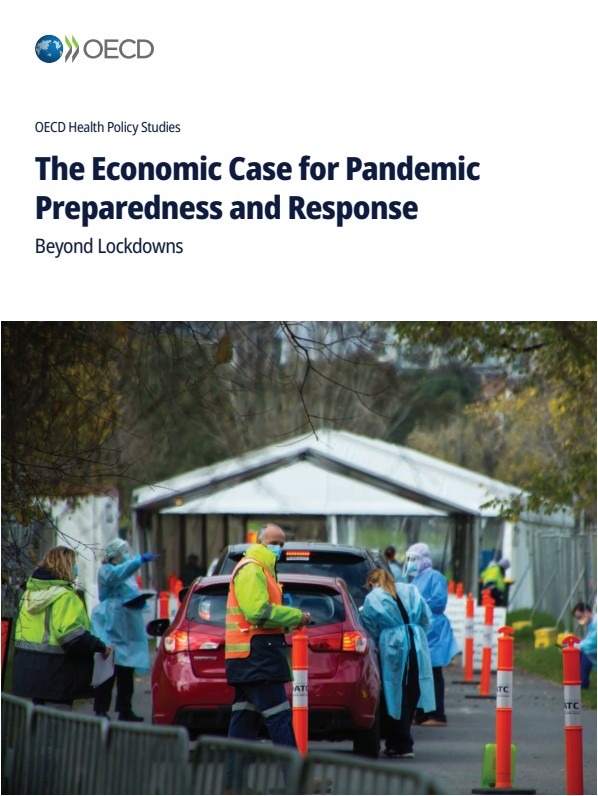
The Economic Case for Pandemic Preparedness and Response: Beyond Lockdowns
(팬데믹 대비 및 대응의 경제적 근거: 봉쇄를 넘어)목차
Foreword 3
Acknowledgements 4
Executive summary 11
1 Assessment and recommendations 15
In Brief 16
1.1. Another pandemic is not a question of if, but when 18
1.2. Taking stock of the impact of the COVID-19 pandemic on population health, healthcare systems and economies 22
1.3. Future pandemics will carry a dual toll: Heavy loss of life and deep economic disruptions 24
1.4. Targeted non-pharmaceutical interventions protect population health and economies in the early days of pandemics 29
1.5. PPR capacity can be greatly strengthened when NPIs are backed by solid foundations 37
1.6. Investing in PPR capacities delivers dividends far beyond moments of crisis 41
1.7. Conclusions 46
References 46
2 The COVID-19 pandemic could have lingering impacts on population health and the economy 52
In Brief 53
2.1. COVID-19 has had an enormous impact on health and societies 55
2.2. COVID-19 had mixed impacts on lifestyle factors that influence the burden of NCDs 66
2.3. The OECD SPHeP-NCDs Model is used to assess the lasting impacts of COVID-19 on NCD burden 71
2.4. Conclusions 77
References 78
Annex 2.A. OECD SPHeP NCDs model 92
3 Future pandemics will carry a dual toll: Heavy loss of life and deep economic disruptions 94
In Brief 95
3.1. The next pandemic is inevitable – are we prepared? 96
3.2. Over the last two decades, the global community experienced several large-scale
pandemics with profound health and economic consequences 98
3.3. Why only certain pathogens have pandemic potential? 99
3.4. The OECD SPHeP-PPR model is used to assess the potential health and economic impacts of five pandemic scenarios 106
3.5. Results 113
3.6. Conclusions 124
References 124
Annex 3.A. Epidemiological factors that contribute to the pandemic potential of pathogens 135
4 Extreme weather events are reshaping the landscape of communicable diseases 139
In Brief 140
4.1. Extreme weather events are rising across the globe 141
4.2. Extreme weather events create new pathways for communicable diseases to emerge, spread and thrive 143
4.3. Disease surveillance systems can be adapted to consider the rising risks of extreme weather events 153
4.4. Conclusions 156
References 156
5 Community-based infection prevention and control measures are the first line of defence during outbreaks 164
In Brief 165
5.1. A primer on community-based IPC measures: What are they and why they are important? 166
5.2. Critical gaps undermine the implementation of community-based IPC measures 168
5.3. Community-based IPC measures are vital to safeguard population health 173
5.4. Improving compliance with community-based IPC measures enhances the effectiveness of these interventions over time 181
5.5. OECD countries can deploy a wide range of policies to promote compliance with community-based IPC measures in the long term 184
5.6. Conclusions 205
References 206
Annex 5.A. List of countries participated in the 2023-2024 OECD Survey on Maintaining Infection Prevention and Control in the Community 217
Annex 5.B. Community-based IPC Implementation Dashboard 219
Annex 5.C. List of influenza pandemic preparedness plans from G7 countries included in the OECD analysis 224
Notes 224
6 Learning from COVID-19 to improve pandemic preparedness indices for future health crises 225
In Brief 226
6.1. The importance of pandemic preparedness and response 227
6.2. A guide to pandemic preparedness and response indices: What they are, how they work and why they matter? 229
6.3. To what extent did pandemic preparedness and response indices reflect countries’ “performance” during COVID-19? 237
6.4. The importance of understanding population vulnerability during a pandemic 241
6.5. Room for development: What can be improved in pandemic preparedness and response indices? 243
6.6. Conclusions 246
References 247
Annex 6.A. The Global Health Security Index (GHSI) utilises open-source data to benchmark a country’s health security capacity 251
Annex 6.B. The Joint External Evaluation (JEE) measures country-specific status and progress in developing capacity to prevent, detect and rapidly respond to public health threats 253
Notes 254
7 Targeted non-pharmaceutical interventions play a key role in safeguarding population health and the economy in the early phases of pandemics 255
In Brief 256
7.1. Non-pharmaceutical interventions are key to safeguarding population health and the economy in the early days of pandemic outbreaks 257
7.2. The varied paths of NPI roll-out during the COVID-19 pandemic 258
7.3. Why do some people follow public health guidelines during pandemics while others ignore them? 269
7.4. Estimating the health and economic consequences of NPIs 271
7.5. Results 281
7.6. Conclusion 292
References 293
Annex 7.A. Impact of non-pharmaceutical interventions 302
Notes 303
8 Investing in pandemic preparedness and response capacities delivers dividends far beyond moments of crisis 304 In Brief 305
8.1. When pandemics strike, countries with stronger PPR systems are better positioned to respond and safeguard population health and the economy 306
8.2. The OECD SPHeP Costing Tool is used to quantify the investment requirements for strengthening PPR capacities 310
8.3. Results 318
8.4. The OECD analysis broadly aligns with cost estimates generated by previous works 323
8.5. Conclusions 326
References 327
Annex 8.A. PPR investment estimates under different assumptions of start-up PPR capacities 331
Annex 8.B. The scope of previous works estimating the investment requirements for strengthening PPR capacities 333
9 Strategic stockpiling is key for timely and effective pandemic preparedness and response strategy 334
In Brief 335
9.1. Introduction 336
9.2. Strategic stockpiling is an important short-term buffer for pandemic preparedness and response 337
9.3. National stockpiling policies vary, but common practical considerations apply 337
9.4. Regional EU stockpiles are an example of co-ordinated strategic stockpiling 345
9.5. Stockpiling policies face several challenges 348
9.6. Conclusions 349
References 350
Annex 9.A. Examples from selected countries 355
Notes 360
해시태그
관련자료



AI 요약·번역·분석 서비스
AI를 활용한 보고서 요약·번역과 실시간 질의응답 서비스입니다.
The Economic Case for Pandemic Preparedness and Response: Beyond Lockdowns
(팬데믹 대비 및 대응의 경제적 근거: 봉쇄를 넘어)
국가전략포털에서 실시간 AI 질의응답 서비스를 시작합니다. 4가지 유형의 요약과 번역을 이용해보시고, 보고서에 대해 추가로 알고 싶은 내용이 있으면 채팅창을 통해 자유롭게 AI에게 물어볼 수 있습니다.
※ 제공하는 정보는 참고용이며, 정확한 사실 확인이 필요할 수 있습니다. 민감한 개인정보는 입력하지 마십시오.