
- 주제별 국가전략 목록으로 이동
- 주제별 국가전략
- 전체
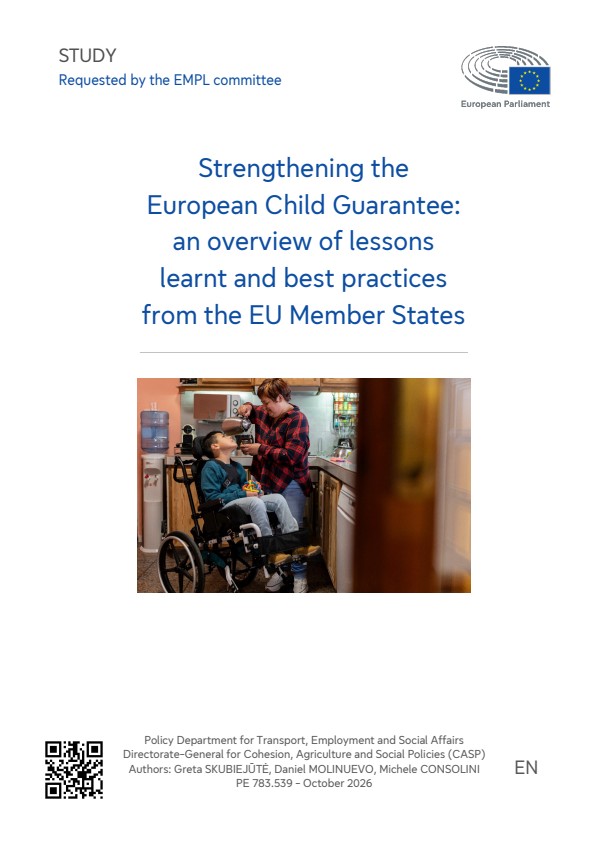
Strengthening the European Child Guarantee: an overview on lessons learnt and best practices from the EU Member States
(유럽 아동보장제도 강화: EU 회원국의 교훈과 모범사례)목차
LIST OF ABBREVIATIONS 6
LIST OF BOXES 8
LIST OF FIGURES 8
LIST OF TABLES 8
EXECUTIVE SUMMARY 9
INTRODUCTION 12
Scope and approach of the study 12
Monitoring trends, disparities and changes over time 13
CHILD POVERTY 16
Trends and changes over time 16
Remaining barriers and drivers of inequalities and child poverty 17
The role of employment 18
Material deprivation and the cost of living 19
Family characteristics and unequal exposure to poverty 19
Fragmented governance and coordination 21
Policies tackling child poverty 22
Strengthening of cash benefits, tax relief and minimum income protection for families with children 22
Supporting the employment of parents and improving work-family balance 24
Reducing essential household expenditure through benefits and services in kind 26
Integrating and locally coordinating anti-poverty interventions 27
Targeted children 28
EARLY CHILDHOOD EDUCATION AND CARE 30
Trends and changes over time 30
Remaining barriers, drivers and inequalities in access to ECEC 35
Affordability of ECEC 36
Availability of suitable provision 37
Indirect barriers to access 38
Workforce quality and shortages 39
Policies promoting access to ECEC 39
Increasing the availability of ECEC places 39
Reducing financial barriers to participation 40
Increasing participation among disadvantaged groups 41
Improving the quality of ECEC services and strengthening the workforce 43
Strengthening governance, planning and integrated service delivery 44
EARLY SCHOOL LEAVING 46
Trends and changes over time 47
Remaining barriers and drivers of early school leaving 49
Socioeconomic disadvantage and educational difficulties 49
Absenteeism, well-being and school environment 51
Groups facing higher risks of early leaving 51
Policies addressing early school leaving 53
Early warning, monitoring and individual case management 53
Personalised learning, language and psychosocial support 54
Promoting cooperation among schools, families, municipalities and community services 56
Reducing material and practical barriers to participation and re-engagement 57
UNMET HEALTHCARE NEEDS 59
Trends and changes over time 59
Remaining barriers, drivers and inequalities in meeting healthcare needs 61
Socioeconomic disadvantage and financial barriers 61
Availability, waiting times and geographical accessibility 62
Administrative, information and institutional barriers 63
Mental healthcare as particular access gap 64
Children facing additional barriers 65
Policies addressing unmet healthcare needs for children 66
Strengthening preventive healthcare and early identification of health and developmental problems 66
Reducing financial, territorial and administrative barriers 67
Improving accessibility to child and adolescent mental healthcare 68
HOUSING COST OVERBURDEN 71
Trends and changes over time 71
Remaining barriers, drivers and inequalities in housing cost overburden 73
Housing affordability pressures: low incomes, rising costs and insufficient affordable housing 73
Housing quality, energy poverty and hidden forms of housing hardship 74
Children most vulnerable to housing-cost overburden and housing exclusion 75
Policies addressing housing cost overburden among families with children 76
Housing allowances, rent subsidies and other assistance with housing expenditure 76
Increasing the supply of affordable housing 78
Addressing energy poverty 78
Eviction prevention, homelessness services and housing-led approaches 79
CROSS-CUTTING IMPLEMENTATION CHALLENGES AND LESSONS LEARNT 81
Governance, coordination and stakeholder involvement 82
Child participation 83
Financing, sustainability and the capacity to use available funds 84
Monitoring and evaluation 87
CONCLUSIONS 89
Trends and changes over time 89
Implementation barriers 90
Policies 91
Policy recommendations 93
REFERENCES 96
ANNEX I: CONVERGENCE METHODOLOGY EXPLAINED 107
ANNEX II: SUMMARY OF CONVERGENCE RESULTS FOR ALL INDICATORS 108
해시태그
관련자료



AI 요약·번역·분석 서비스
AI를 활용한 보고서 요약·번역과 실시간 질의응답 서비스입니다.
Strengthening the European Child Guarantee: an overview on lessons learnt and best practices from the EU Member States
(유럽 아동보장제도 강화: EU 회원국의 교훈과 모범사례)
국가전략포털에서 실시간 AI 질의응답 서비스를 시작합니다. 4가지 유형의 요약과 번역을 이용해보시고, 보고서에 대해 추가로 알고 싶은 내용이 있으면 채팅창을 통해 자유롭게 AI에게 물어볼 수 있습니다.
※ 제공하는 정보는 참고용이며, 정확한 사실 확인이 필요할 수 있습니다. 민감한 개인정보는 입력하지 마십시오.