
- 주제별 국가전략 목록으로 이동
- 주제별 국가전략
- 전체
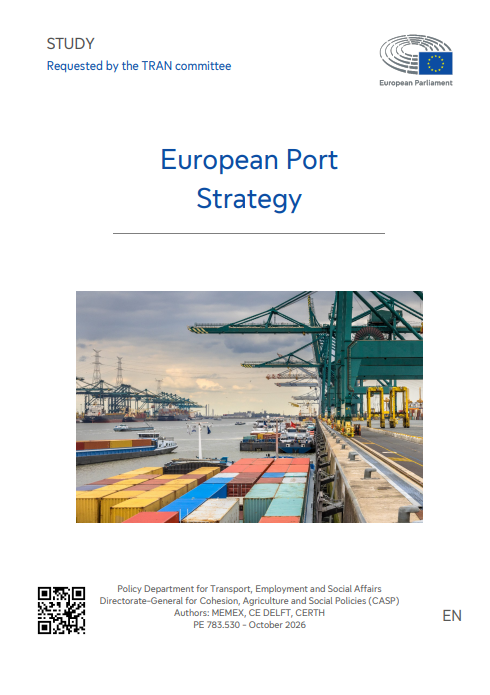
European Port Strategy
(유럽 항만 전략)목차
LIST OF ABBREVIATIONS 8
LIST OF BOXES 11
LIST OF FIGURES 11
LIST OF TABLES 12
EXECUTIVE SUMMARY 14
1. INTRODUCTION 18
1.1. Background and context 18
1.1.1.The European port system 18
1.1.2. Evolving role and EU policy context 20
1.2. Study objectives 21
1.3. Study outline 22
2. GLOBAL COMPETITIVENESS 23
2.1. Context 23
2.1.1. Conceptualising port competitiveness 24
2.1.2. Port competitiveness from an EU policy perspective 25
2.1.3. Three relevant port competitiveness factors for EU policy 25
2.2. Vulnerability of transhipment hubs 26
2.2.1. Regulatory exposure and cargo diversion risks for EU transhipment hubs 26
2.2.2. Current evidence on cargo diversion and business leakage 28
2.3. Port costs and efficiency 31
2.3.1. Port efficiency as a driver of competitiveness 31
2.3.2. Policy-relevant barriers to EU port competitiveness 32
2.4. Technological leadership as driver of global competitiveness 35
2.4.1. Technology as a driver of future port competitiveness 35
2.4.2. Future port technologies and EU competitive positioning 36
2.5. Conclusion 38
2.5.1. Thematic assessment of the EU Ports Strategy 38
2.5.2. Key takeaways 39
3. SAFETY AND SECURITY 41
3.1. Context 41
3.2. Cybersecurity and digital security of EU ports 43
3.2.1. Stakeholder views on cybersecurity and digital resilience 45
3.2.2. Assessment of the current EU framework 45
3.3. Protection of critical port infrastructure and resilience against security threats 47
3.3.1. Stakeholder views on infrastructure resilience and security threats 48
3.3.2. EU policy and regulatory framework for infrastructure resilience and security 50
3.4. Illegal activities, organised crime, and border security 51
3.4.1. Dual-use requirements of port-hinterland corridors 52
3.4.2. Governance, corridor coordination and proportionality 53
3.5. Conclusions 53
3.5.1. Thematic assessment of the EU Ports Strategy 53
3.5.2. Key takeaways 54
4. ENERGY TRANSITION AND DECARBONISATION 55
4.1. Context 56
4.1.1. Conceptualising sustainability and energy transition in the context of ports 56
4.1.2. Port and shipping diversity in the energy transition 56
4.1.3. Focus areas for EU port policy 57
4.2. Alternative fuels and port readiness 58
4.2.1. Port role and readiness for alternative fuel deployment 58
4.2.2. Multi-fuel transition, EU policy and coordination challenges 59
4.3. Port electrification 62
4.3.1. Role of port electrification in the energy transition 62
4.3.2. OPS deployment, grid capacity and pricing 62
4.4. Energy efficiency in port operations and industrial clusters 65
4.4.1. Role of energy efficiency in port operations and industrial clusters 65
4.4.2. EU framework and implementation barriers 65
4.5. Conclusions 66
4.5.1. Thematic assessment of the EU Ports Strategy 66
4.5.2. Key takeaways 67
5. DIGITAL SYSTEMS 69
5.1. Context 69
5.1.1. Relevant port digitalisation dimensions 70
5.1.2. Drivers for ports digitalisation 70
5.2. Adoption of digital systems and solutions in ports 72
5.2.1. Analytical approach 72
5.2.2. Synthesis of the analysis of the selected ports 72
5.2.3. Cross-cutting findings 75
5.3. Data sharing and governance 76
5.3.1. Port Community Systems as interoperability enablers 77
5.3.2. Persistent challenges and barriers 78
5.4. Innovative digital solutions for port operations 79
5.4.1. Innovation ecosystems and operational transformation in ports and logistics supply chains 79
5.4.2. From innovation pilots to operational deployment 81
5.4.3. Towards an integrated European digital ecosystem 82
5.5. Conclusions 83
5.5.1. Thematic assessment of the EU Ports Strategy 83
5.5.2. Key takeaways 84
6. HINTERLAND CONNECTIVITY 86
6.1. Context 86
6.1.1. Scope and policy relevance 86
6.1.2. EU policy framework and implementation gap 87
6.1.3. Dimensions of port-hinterland connectivity 87
6.2. Multimodal port connectivity and hinterland integration 89
6.2.1. Policy and analytical framing 89
6.2.2. Modal and port-corridor integration 90
6.2.3. Inland terminals and synchromodal coordination 91
6.2.4. Effective multimodal integration and remaining bottlenecks 91
6.3. Dual-use Infrastructure and strategic resilience 92
6.3.1. Infrastructure requirements for military mobility 92
6.3.2. Port- corridor planning and proportionality 94
6.4. Financial instruments and investments 95
6.4.1. Investment needs and funding landscape 95
6.4.2. From separate instruments to integrated port-access packages 96
6.4.3. Funding barriers and future alignment needs 98
6.5. Conclusions 98
6.5.1. Thematic assessment of the EU Ports Strategy 98
6.5.2. Key takeaways 99
7. STRATEGIC FRAMEWORK FOR STRENGTHENING THE COMPETITIVENESS OF EU PORTS
AND COMPARATIVE ASSESSMENT 100
7.1. Strategic framework for strengthening the competitiveness of EU ports 100
7.1.1. Integrated governance, competitiveness monitoring and long-term planning. 101
7.1.2. Coordinated investment, digital transformation and innovation deployment. 101
7.1.3. Logistics ecosystems, industrial integration and resilient connectivity. 102
7.2. Comparative assessment conceptual and methodological approach 102
7.2.1. International port competitiveness as market position and system capability 102
7.2.2. Cargo-market and regional differentiation 104
7.2.3. Comparative method, indicators and case selection 105
7.3. Use case: Port of Singapore 107
7.3.1. Context and competitive position 107
7.3.2. Integrated governance, competitiveness monitoring and long-term planning 109
7.3.3. Coordinated investment, digital transformation and innovation deployment 109
7.3.4. Logistics ecosystems, industrial integration and resilient connectivity 110
Use case: Tanger Med 112
7.3.5. Context and competitive position 112
7.3.6. Integrated governance, competitiveness monitoring and long-term planning 114
7.3.7. Coordinated investment, digital transformation and innovation deployment 115
7.3.8. Logistics ecosystems, industrial integration and resilient connectivity 115
7.4. Comparative findings and relevance for the EU port system 116
7.4.1. Integrated governance, competitiveness monitoring and long-term planning 117
7.4.2. Coordinated investment, digital transformation and innovation deployment 118
7.4.3. Logistics ecosystems, industrial integration and resilient connectivity 118
7.4.4. Transferability across EU maritime regions and cargo markets 119
7.5. Conclusions 120
7.5.1. Key takeaways 120
8. ALTERNATIVE FUTURE SCENARIOS 122
8.1. Scenario framework 122
8.1.1. S1: Fragmented Fossil Security 124
8.1.2. S2: Green competition 124
8.1.3. S3: Open Trade, Weak Global Climate Action 125
8.1.4. S4: Green Cooperation 125
8.2. Conclusions 126
9. CONCLUSIONS AND POLICY RECOMMENDATIONS 127
9.1. Synopsis of the assessment of the EU Ports Strategy 128
9.2. Consolidated policy recommendations 129
9.2.1. Global competitiveness 129
9.2.2. Safety and security 130
9.2.3. Energy transition 131
9.2.4. Digitalisation 133
9.2.5. Hinterland connectivity 134
9.3. Scenario sensitivity of policy recommendations 135
9.4. Conclusion 136
REFERENCES 137
ANNEX 1: METHODOLOGICAL APPROACH 154
ANNEX 2: STAKEHOLDER CONSULTATION 158
Stakeholder selection 158
Stakeholder consultation results 161
ANNEX 3: SCENARIO ASSESSMENT 164
Global competitiveness 164
Safety and security 165
Sustainability and energy transition 167
Digital systems 169
Hinterland connectivity 170
ANNEX 4: ADDITIONAL PORT-SPECIFIC REFERENCES AND SOURCES 172
해시태그
관련자료



AI 요약·번역·분석 서비스
AI를 활용한 보고서 요약·번역과 실시간 질의응답 서비스입니다.
European Port Strategy
(유럽 항만 전략)
국가전략포털에서 실시간 AI 질의응답 서비스를 시작합니다. 4가지 유형의 요약과 번역을 이용해보시고, 보고서에 대해 추가로 알고 싶은 내용이 있으면 채팅창을 통해 자유롭게 AI에게 물어볼 수 있습니다.
※ 제공하는 정보는 참고용이며, 정확한 사실 확인이 필요할 수 있습니다. 민감한 개인정보는 입력하지 마십시오.