
- 주제별 국가전략 목록으로 이동
- 주제별 국가전략
- 전체
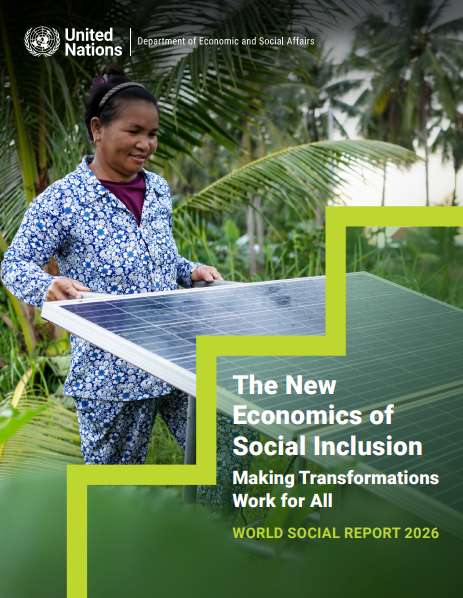
World Social Report 2026 - The New Economics of Social Inclusion: Making Transformations Work for All
(2026 세계사회보고서: 사회적 포용의 새로운 경제학 — 모두를 위한 전환)□ UN, 경제·디지털·에너지 전환 속 사회적 포용 강조
ㅇ 유엔 경제사회국(UN DESA)은 2026년 10월 15일 「2026 세계사회보고서」를 발표하고 경제·디지털·에너지 전환이 빠르게 진행되는 가운데 일자리·기술·서비스·인프라와 사회보호에서 배제 문제가 지속되고 있다고 분석했음
ㅇ 전 세계적으로 비공식 고용과 디지털 격차 등이 지속되면서 기술혁신과 기후변화에 대응할 역량의 격차가 생산성과 경제 회복력을 제약하고 있는 것으로 나타났음
ㅇ 보고서는 경제·디지털·에너지 전환 수준이 높더라도 그 성과가 사회적 포용으로 자동 연결되지는 않는다며 국가별 전환 성과와 포용 수준 간 상당한 차이를 확인했음
ㅇ 특히 사회보호 투자를 늦출수록 경제적 비용이 커질 수 있다며 교육·AI 역량 강화, 사회보호와 노동시장 지원, 디지털·에너지 접근성 확대 등을 주요 과제로 제시했음
□ 세계사회보고서, 글로벌 사회적 배제 현황 진단
ㅇ 세계사회보고서는 UN DESA가 주요 사회개발 현안을 분석하는 대표 보고서로, 2026년판은 경제·디지털·에너지 전환 과정에서 발생하는 사회적 배제와 포용의 경제적 효과를 중점적으로 분석했음
ㅇ 2025년 기준 전 세계 노동자의 58%가 비공식 고용 상태였으며, 15~24세 여성의 27%가 취업·교육·훈련에 참여하지 않은 것으로 나타났음
ㅇ 인터넷 미접속 인구가 세계 인구의 26%에 달했으며,연결망과 기기·데이터·AI 활용 역량에 대한 접근 격차가 교육·소득·경제적 기회의 격차를 심화시킬 위험이 있는 것으로 분석됐음
ㅇ 다차원 빈곤 상태인 11억 명 가운데 8억8,700만 명이 하나 이상의 주요 기후위험에 노출돼 취약계층과 자원이 부족한 국가에 기후변화의 부담이 집중되고 있음
□ 전환 성과와 사회적 포용 간 격차 확인
ㅇ 2026년판은 지난 25년간 168개국의 경제·디지털·에너지 전환과 포용 수준을 함께 평가하는 사회적으로 포용적인 전환(SIT) 평가체계를 제시했음
ㅇ 전환 수준 상위 5개국인 몰타·아일랜드·미국·싱가포르·중국은 포용성 상위 5개국에는 포함되지 않아, 높은 전환 성과가 곧바로 사회적 포용으로 이어지지는 않는 것으로 나타났음
ㅇ 한국은 미국·싱가포르와 함께 디지털 선도국으로 분류됐으나 포용성 부문 상위 5개국에는 포함되지 않은 것으로 나타났음
□ 사회적 포용 지연에 따른 경제비용 확대 경고
ㅇ 일부 국가 대상 시뮬레이션에서는 사회보호 투자를 10년 늦출 경우 조기에 투자한 국가보다 경제 산출이 약 12% 낮아질 수 있는 것으로 분석됐음
ㅇ 보고서는 사회적 포용을 단순한 복지비용이 아니라 노동력 활용과 인적자본, 혁신·창업, 생산성 확산을 촉진하는 생산적 투자로 접근할 필요가 있다고 강조했음
ㅇ 주요 정책 과제로 교육·평생학습·디지털 및 AI 역량 강화, 보편적 사회보호와 디지털·에너지 접근성 확대, 양질의 일자리와 노동이동 지원, 전환 이익의 공정한 분배를 제시했음
ㅇ 개발도상국의 재정·기술·제도적 제약을 고려해 장기 개발금융 접근성 확대와 부채부담 완화, 기술·디지털 인프라 접근 확대를 위한 국제협력 강화도 촉구했음
[출처]
As societies transform, people are falling behind, with rising costs of exclusion, new UN report warns (2026.10.15.) / United Nations Department of Economic and Social Affairs (UN DESA)
World Social Report 2026 - The New Economics of Social Inclusion: Marking Transformations Work for All (2026.10.15.) / United Nations Department of Economic and Social Affairs (UN DESA)
목차
Foreword 3
Explanatory Notes 4
Abbreviations 5
Acknowledgements 7
Executive Summary 13
1. The New Economics of Social Inclusion 19
Introduction 20
The importance of social inclusion 21
Uneven, incomplete progress on social inclusion 22
New and emerging challenges to social inclusion 23
The risk of widening inequalities and exclusions from digital and AI divides 23
The potential for climate change to weaken livelihoods, services and adaptive capacity 26
The capacity of energy transitions to expand resilience, while distributional risks remain 28
The continuing effect of geopolitical pressures on challenges to social inclusion 28
The mounting costs of social exclusion 30
The speed and scale of transformations and their impact on exclusion 30
The economic cost of exclusion and delayed inclusion 30
The New Economics of Social Inclusion 32
Guiding principles of the New Economics of Social Inclusion 33
How NESI advocates for socially inclusive transformation 34
Policy compact for socially inclusive transformation 36
Conclusions 36
2. Towards a Socially Inclusive Transformation 39
Introduction 40
Benchmarking socially inclusive transformation 40
Economic transformation 40
Energy transformation 41
Digital transformation 41
Economic equity 41
Social equity 42
Benchmarking progress on SIT: key insights 43
Increased socially inclusive transformation scores with a rise in income, but vastly different scores among countries at similar levels of income 43
Progress in transformation not always accompanied by inclusiveness 43
Uneven progress across different transformations and equity dimensions, with social equity and energy transformation emerging as the weakest links 44
SIT dashboard for LDCs, LLDCs and SIDS 44
Sharply divergent pathways in middle-income countries, with low-income countries furthest behind in terms of digital transformation and social equity 46
Leaders in transformation and inclusion 47
Conclusions 47
3. Challenges and Opportunities in Advancing Socially Inclusive Transformation 49
Introduction 50
The persisting deficits across key dimensions of social inclusion 50
Barriers to economic participation 50
Barriers to education and skill development 54
Inequities in healthcare access and outcomes 55
Deficits in voice and representation 57
New opportunities and challenges that transformation presents 57
New opportunities from economic transformations 58
Digital technologies and artificial intelligence 61
The energy transformation 67
Conclusions 69
4. Institutions and Policies for Socially Inclusive Transformation 71
Introduction 72
Expanding people’s access to education, health, and social protection 72
Education: from opportunity to skills for the future 72
Health systems for building resilience and socially inclusive transformations 75
Providing universal social protection in a digital era 77
Universal access to digital and green energy services 78
Advancing inclusive digital transformation 78
Energy access for all 79
Fostering inclusive labour markets during technological and green transformations 80
Decent work and portable benefits for gig workers 80
Active labour market policies during technological and green transformations 81
Reducing gender pay gaps 82
Steering innovation towards employment creation 83
Policies and institutions for ensuring shared prosperity 83
Improving labour’s share of income 84
Fiscal policies: taxation for socially inclusive transformation 87
Policy coherence, sequencing and coordination 90
Conclusions 90
5. International Cooperation for a Socially Inclusive Transformation 93
Introduction 94
A paradigm shift in national development planning 94
From structural transformation to socially inclusive transformation 94
From wage-only employment to diversified livelihood and compensation for nonmarket value generation 95
From one-degree-for-lifetime to lifelong learning 95
From extractive to regenerative digital economic systems 95
From concentrated ownership to distributed participation, including in digital and green assets 95
From reactive to anticipatory governance for shaping future transformations 96
From global competition to global cooperation on shared infrastructures 96
Strengthening international cooperation and multilateralism in an increasingly fragmenting world 96
The gains of multilateralism despite persisting challenges 96
International cooperation in taxing the digital economy 97
Multilateralism weakened by geopolitical fragmentation 98
The way forward 100
Bibliography 101
Appendix 111
Socially inclusive transformation (SIT) scores by country 111
Figures
1.1 Persistent gaps across key dimensions of inclusion 22
1.2 Rising within-country income inequalities 24
1.3 Growing income gaps: 1950–2022 25
1.4 How the digital divide and the AI divide hinder social inclusion 25
1.5 How climate change hinders social inclusion 27
1.6 Disaster driven internal displacements in 2024 27
1.7 Geopolitical fragmentation and social inclusion 29
1.8 Immediate versus delayed investments in social inclusion, 2025–2045 31
1.9 The New Economics of Social Inclusion: making transformations work for all 35
2.1 Socially inclusive transformation (SIT) scores and income levels 43
2.2 Global patterns in socially inclusive transformation 44
2.3 Regional performance across sub-pillars 45
2.4 Socially inclusive transformation (SIT) in countries in special situations and other developing countries 45
2.5 Performance across sub-pillars, by income group 46
3.1 Male and female labour force participation rate, 1990–2025 51
3.2 Labour force status by disability status and region, 2025 or latest available year 52
3.3 Percentage and composition of informal employment as a share of total employment, by sex and country income group, 2023 54
3.4 Minimum proficiency in mathematics at the end of lower-secondary education, 2022 or latest available year 55
3.5 Proportion of women experiencing problems in accessing healthcare, 2024 or latest available year 56
3.6 Share of non-agricultural agrifood systems employment in total employment 60
3.7 Changes in employment by disability status, 2019–2022 64
4.1 Tax revenue and public health spending, per capita, 2024 76
4.2 Social protection benefits, effective global coverage, 2017–2023 77
4.3 Relative redistribution through taxes and transfers, median, by country group, 2000 and latest year available 87
Boxes
1.1 Comparing structural transformation, integrated inclusive development, and the New Economics of Social Inclusion 33
2.1 Methodology of the socially inclusive transformation (SIT) score 42
3.1 Youth employment policies shifting South Africa’s growth path 59
3.2 Impacts of artificial intelligence on the energy transition: risks and opportunities 61
3.3 Harnessing digital transformation and AI for the inclusion of Communities Discriminated on Work and Descent 65
5.1 Debt relief and social development: evidence from the Heavily Indebted Poor Countries Initiative 98
5.2 Strengthening international tax cooperation for social inclusion 99
Figure boxes
3.1.1 Simulated economic effects of youth employment policies in South Africa 59
Tables
2.1 Top five countries by each pillar and combined SIT score 47
2.2 Top five countries in terms of their scores under each sub-pillar 47
4.1 Policy interventions by area and objectives for equity, adaptation and resilience 92
해시태그
관련자료



AI 요약·번역·분석 서비스
AI를 활용한 보고서 요약·번역과 실시간 질의응답 서비스입니다.
World Social Report 2026 - The New Economics of Social Inclusion: Making Transformations Work for All
(2026 세계사회보고서: 사회적 포용의 새로운 경제학 — 모두를 위한 전환)
국가전략포털에서 실시간 AI 질의응답 서비스를 시작합니다. 4가지 유형의 요약과 번역을 이용해보시고, 보고서에 대해 추가로 알고 싶은 내용이 있으면 채팅창을 통해 자유롭게 AI에게 물어볼 수 있습니다.
※ 제공하는 정보는 참고용이며, 정확한 사실 확인이 필요할 수 있습니다. 민감한 개인정보는 입력하지 마십시오.