
- 주제별 국가전략 목록으로 이동
- 주제별 국가전략
- 전체
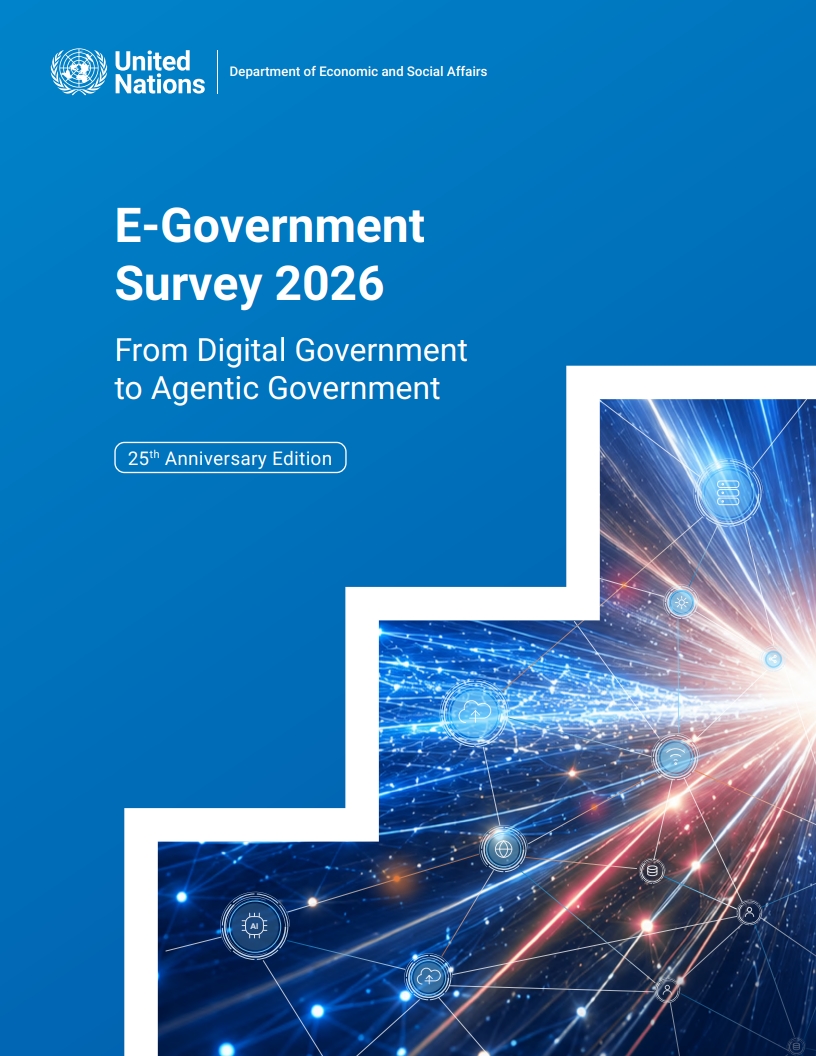
E-Government Survey 2026: From Digital Government to Agentic Government
(2026 유엔 전자정부 평가: 디지털정부에서 에이전틱 정부로의 전환)□ 한국, 2026 유엔 전자정부평가 세계 1위 달성
ㅇ 11월 19일 유엔 경제사회국(UN DESA)이 발표한 「2026 유엔 전자정부평가」 보고서에서 한국이 194개국 중 세계 1위를 기록했으며, 이는 2014년 이후 12년 만으로, 2024년보다 3계단 상승한 결과임
ㅇ 한국의 전자정부발전지수(EGDI)는 0.9794점으로 덴마크(0.9777점), 싱가포르(0.9722점)를 앞섰으며, 온라인서비스·통신인프라·인적자본 등 3개 분야를 종합한 평가에서 1위를 차지함
ㅇ 정부24의 맞춤형 서비스, 모바일 신분증, 공공마이데이터 등 디지털 행정 기반이 주요 성과로 제시됐으며, 디지털 취약계층의 서비스 접근성 개선도 긍정적인 평가 요인으로 분석됨
ㅇ 정부는 올해 보고서의 주제인 '디지털정부에서 에이전틱 정부로의 전환'에 연계해 24시간 AI 상담·AI 국민비서 구축 등 AI 기반 공공서비스 확대를 추진할 계획임
□ 전자정부평가 순위 상승과 분야별 성과
ㅇ 유엔 경제사회국(UNDESA)은 2년마다 온라인서비스지수(OSI), 통신인프라지수(TII), 인적자본지수(HCI)를 종합해 각국의 전자정부 발전 수준을 평가함
ㅇ 한국은 2010~2014년 3회 연속 종합 1위를 기록했으나 이후 2020년 2위, 2022년 3위, 2024년 4위로 하락했으며, 2026년 1위를 회복함
ㅇ 분야별로 온라인서비스 4위, 통신인프라 5위, 인적자본 11위를 기록했으며, 직전 평가 대비 온라인서비스는 3계단 하락한 반면 통신인프라는 1계단, 인적자본은 6계단 상승함
ㅇ 올해 통신인프라 평가에 '전자정부 인프라' 지표가 신설되고, 2024년 도입된 '전자정부 문해력' 지표도 반영되면서 디지털 신원 인증·데이터 연계와 공공서비스 활용 역량이 주요 평가 요소로 작용함
□ 맞춤형 공공서비스와 디지털 행정 기반 강화
ㅇ 온라인서비스 분야에서는 정부24를 중심으로 국민비서·혜택알리미 등을 연계해 국민의 생애주기와 상황에 맞는 행정서비스를 제공한 점이 주요 성과로 제시됨
ㅇ 혜택알리미는 구직·출산 등 개인별 상황에 따라 약 7,000개 정부 지원 혜택을 안내해 필요한 지원제도를 직접 찾아야 하는 불편을 줄이는 서비스임
ㅇ 모바일 신분증을 통한 디지털 신원 확인과 공공마이데이터를 통한 기관 간 행정정보 연계로 본인 확인과 증빙서류 제출의 편의성을 높인 점도 긍정적으로 평가됨
ㅇ 또한 고령자·장애인 등 디지털 취약계층을 위해 공공 누리집의 글자 크기 조절, 이용 안내 개선, 웹 접근성 강화 등을 추진해 서비스 이용 편의를 높임
□ AI 민주정부 구현과 공공서비스 혁신 추진
ㅇ 행정안전부는 국민의 요청과 상황을 이해하고 필요한 서비스를 능동적으로 제공하는 'AI 민주정부' 구현을 추진하며, AI 기반 행정서비스 확대에 나설 계획임
ㅇ 국민 생활 분야에서는 24시간 AI 상담과 'AI 국민비서'를 구축하고, 여러 행정기관의 민원을 통합적으로 처리할 수 있는 AI 통합민원서비스를 추진함
ㅇ 정책·행정 분야에서는 '모두의 광장'과 'AI 정부 실험실' 등을 활용해 국민 의견의 정책 반영과 행정업무 개선을 지원하고, 공공부문 AI 전문 인재 양성도 강화할 예정임
ㅇ 아울러 개인정보 보호와 AI 활용 위험요인 사전 점검을 강화하고, 국내 AI·디지털정부 서비스의 해외 진출도 지원할 방침임
[출처]
한국, UN 전자정부평가 '세계 1위'…정부24·모바일 신분증 등 호평 (2026.11.20.) / 대한민국 정책브리핑
한국, 유엔 전자정부 평가 12년 만에 세계 1위 탈환…194개국 중 정상 (2026.11.20.) / 뉴스1
목차
Preface v
Acknowledgements vii
Acronyms viii
About the Survey xv
Executive Summary xvii
1. GLOBAL TRENDS IN E-GOVERNMENT 1
1.1 Introduction 1
1.2 EGDI methodology: what is new 3
1.3 E-government development at a glance 3
1.4 Movements between EGDI groups in 2024 to 2026 5
1.5 Global and regional improvements in EGDI and subindices (OSI, TII and HCI) 7
1.5.1 Progress in Countries in Special Situations (CSS) 8
1.5.2 Key implications 8
1.6 Countries leading e-government development 9
1.7 National income and e-government development 11
1.8 Online Services Index 13
1.8.1 Country groupings by Online Services Index (OSI) and EGDI levels 13
1.8.2 Online Services Index subindices 16
1.8.3 Online Services Index institutional framework subindex—Legislative Framework 17
1.8.4 Online Services Index content provision subindex 18
1.8.5 Online Services Index participation and engagement subindex 19
1.8.6 Online Services Index service provision subindex 22
1.8.7 Sector-specific online information and services: sharing via mobile technologies 28
1.8.8 Targeted services for people in vulnerable situations 29
1.8.9 Public procurement services 32
1.8.10 Technology subindex and digital infrastructure development 33
1.9 Summary of key findings and policy recommendations 37
Endnotes 41
2. Megatrends: Regional Country Groupings 43
2.1 Introduction 43
2.2 Megatrends at the regional level 43
2.3 Regional country grouping analysis 48
2.3.1 Africa: Accelerating digital transformation through digital public infrastructure and adaptive transformation 48
2.3.2 Americas: Continued regional improvement with new upward movement across the Caribbean 52
2.3.3 Asia: Expanding digital government capacity beyond traditional regional front-runners 55
2.3.4 Europe: Sustained leadership and broader convergence in digital government 60
2.3.5 Oceania: Stronger digital momentum driven by Pacific SIDS transformation 65
2.4 Bridging the population-weighted digital divide: progress, challenges and disparities 67
2.4.1 A proxy to measure the digital divide 67
2.4.2 Africa: a broad and deep population-weighted digital divide 70
2.4.3 Americas: a relatively limited but concentrated population-weighted digital divide 71
2.4.4 Asia: strong aggregate performance alongside a differentiated population-weighted digital divide 73
2.4.5 Europe: the narrowest population-weighted digital divide 74
2.4.6 Oceania: strong progress alongside a persistent SIDS digital divide 75
2.5 Key takeaways 76
Endnotes 77
3. Local E-Government and Cities 81
3.1 Introduction 81
3.1.1 Cities, digital transformation and sustainable development 81
3.1.2 Measuring local digital government: methodology and scope 83
3.1.3 Limitations and caveats 84
3.1.4 Local Government Questionnaire 84
3.2 Current status of local online services 85
3.2.1 Small island developing States and other countries that are small in size and population 89
3.2.2 The impact of population size 89
3.3 Implementation of LOSI indicators in city portals 90
3.3.1 Institutional framework 91
3.3.2 Content provision 92
3.3.3 Service provision 95
3.3.4 Participation and engagement 96
3.3.5 E-government literacy 97
3.3.6 E-government infrastructure 98
3.4 Smart cities for sustainable development 99
3.5 Key findings and recommendations 101
Endnotes 102
4. The Artificial Intelligence Evolution of Public Services: Exploring the Shift toward Agentic Government 103
4.1 From digital transformation to AI-enabled public administration 103
4.2 Toward outcome-oriented and AI-enabled public administration 107
4.2.1 Increased autonomy and reallocation of human judgment 108
4.2.2 Embedded intelligence in government structure 108
4.2.3 Faster, evidence-based policy adjustment 108
4.2.4 Improving accessibility and equity: leaving no one behind in practice 108
4.2.5 Robust data governance as institutional foundation 109
4.3 Digital and data sovereignty as foundations for Agentic Government 109
4.4 From AI readiness indices to measuring Agentic Government 111
4.4.1 Government AI Readiness Index 111
4.4.2 Stanford AI Index Report 112
4.4.3 Global AI Index 112
4.4.4 Towards an Agentic Government Index 112
4.5 From the digital divide to the AI divide: readiness, capacity and global governance 113
4.6 The United Nations response to the AI divide: governance, capacity and system-wide coordination 115
4.7 International, regional and national AI cooperation hubs: building shared capacity for responsible public-sector transformation 116
4.8 Towards a United Nations Platform for Digital Government Cooperation, Innovation and R&D 118
4.9 Conclusion and key recommendations 120
Endnotes 122
ANNEX 124
E-Government Development Index (EGDI) 2026 by countries 124
해시태그
관련자료



AI 요약·번역·분석 서비스
AI를 활용한 보고서 요약·번역과 실시간 질의응답 서비스입니다.
E-Government Survey 2026: From Digital Government to Agentic Government
(2026 유엔 전자정부 평가: 디지털정부에서 에이전틱 정부로의 전환)
국가전략포털에서 실시간 AI 질의응답 서비스를 시작합니다. 4가지 유형의 요약과 번역을 이용해보시고, 보고서에 대해 추가로 알고 싶은 내용이 있으면 채팅창을 통해 자유롭게 AI에게 물어볼 수 있습니다.
※ 제공하는 정보는 참고용이며, 정확한 사실 확인이 필요할 수 있습니다. 민감한 개인정보는 입력하지 마십시오.