
- 주제별 국가전략 목록으로 이동
- 주제별 국가전략
- 전체
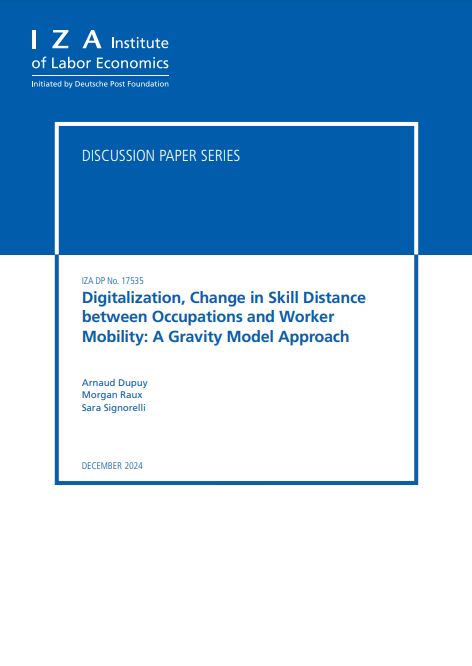
Digitalization, change in skill distance between occupations and worker mobility : a gravity model approach
(디지털화에 따른 직업 간 기술 변화와 노동 이동성 분석 : 중력 모형 접근)목차
Title page
Contents
Abstract 3
1. Introduction 4
2. Conceptual framework 9
3. Data 14
3.1. Measuring skills distance 14
3.2. Occupation mobility 20
3.3. Final sample 21
4. Agravity model approach 22
5. Empirical results 26
6. The model 32
6.1. Workers' and jobs' types 32
6.2. Matching 33
6.3. Match values and choices 34
6.4. Equilibrium 35
6.5. Identification 36
6.6. Computation 38
6.7. Estimation 40
7. Counterfactual analysis 41
8. Conclusion 45
References 47
Appendix 52
A. Additional Tables and Figures 52
B. Model extensions 64
Table 1. Summary statistics 22
Table 2. Effects of distance and digital distance on mobility flows 27
Table 3. Robustness of the effect of changes in digital distance on end-line mobility flows 29
Table 4. Counterfactual results on occupation switchers 43
Table 5. Counterfactual results on mobility to non-employment 45
Figure 1. Visualization of the conceptual framework 11
Figure 2. Evolution of skill distance over the period 19
Table A1. List of occupations classified as fully digital 58
Table A2. Effect of distance and digital distance on mobility flows using distance measures assuming skill obsolescence 59
Table A3. Robustness of the effect of changes in digital distance on long run mobility flows 60
Table A4. Effect of distance and digital distance on mobility flows using distance measures that exclude generic skills and using a more aggregate classification of occupations 61
Table A5. Robustness of the effect on long run mobility flows to following age cohorts 62
Table A6. Structural estimation of mobility and wage equations 63
Table A7. Counterfactual results on stayers 63
Figure A1. The 25 skills with the highest growth in demand over 2011-2019 52
Figure A2. Visualization of the conceptual framework 53
Figure A3. Digital intensity of occupations in 2011 54
Figure A4. Correlation between distance in 2011 and in 2019 by occupation pairs 54
Figure A5. Correlation between distance in 2011 and change in distance between 2011 and 2019 by occupation pairs 55
Figure A6. Matrix of bilateral flows from 2011 to 2012 56
Figure A7. Linearity of the effect of skill distance and digital skill distance 57
Figure A8. Distribution of growth rates in employment shares across occupations 57
해시태그
관련자료



AI 요약·번역·분석 서비스
AI를 활용한 보고서 요약·번역과 실시간 질의응답 서비스입니다.
Digitalization, change in skill distance between occupations and worker mobility : a gravity model approach
(디지털화에 따른 직업 간 기술 변화와 노동 이동성 분석 : 중력 모형 접근)
국가전략포털에서 실시간 AI 질의응답 서비스를 시작합니다. 4가지 유형의 요약과 번역을 이용해보시고, 보고서에 대해 추가로 알고 싶은 내용이 있으면 채팅창을 통해 자유롭게 AI에게 물어볼 수 있습니다.
※ 제공하는 정보는 참고용이며, 정확한 사실 확인이 필요할 수 있습니다. 민감한 개인정보는 입력하지 마십시오.