
- 주제별 국가전략 목록으로 이동
- 주제별 국가전략
- 전체
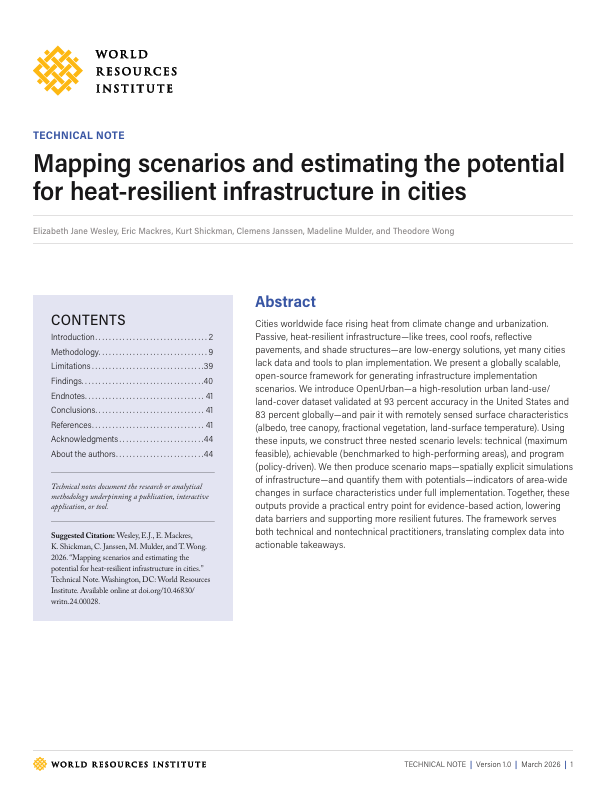
Mapping scenarios and estimating the potential for heat-resilient infrastructure in cities
(도시의 폭염 대응 인프라 구축 가능성 평가 및 시나리오 분석)목차
Title page 1
Contents 1
Abstract 1
Introduction 2
Methodology 9
Limitations 39
Findings 40
Conclusions 41
Endnotes 41
References 41
Acknowledgments 44
About the authors 44
Table 1. Cities engaged in our user research process to understand needs for long-term adaptation to rising temperatures 9
Table 2. OpenUrban LULC category definitions and datasets 12
Table 3. Input datasets for OpenUrban 13
Table 4. OSM categories and category types used to identify features of interest for the OpenUrban dataset 14
Table 5. Accuracy assessment of OpenUrban for US cities 17
Table 6. Accuracy assessment of OpenUrban for global cities 17
Table 7. Comparison of overall accuracy of different land cover datasets 18
Table 8. Input datasets for measuring surface characteristics 19
Table 9. DynamicWorld LULC categories are recategorized to estimate NDVI₀ (built-up) and NDVIveg (vegetated) 21
Table 10. Summary of potentials for the Cape Town AOI scenarios 26
Table 11. Cool roof material potential 30
Table 12. OSM road category types used to classify road traffic volume 34
Table 13. Material options for reflective pavements based on traffic volume 34
Figure 1. Our framework for mapping scenarios and estimating potential for heat-resilient infrastructure, using street trees as an example 3
Figure 2. Cool Cities Lab workflow 4
Figure 3. Heat-resilient infrastructure scenario framework 8
Figure 4. OpenUrban data for Portland, Oregon (United States) 10
Figure 5. OpenUrban data for Istanbul 11
Figure 6. Roof slope classification (United States only) 15
Figure 7. Tree (left) and cool roof (right) opportunity in Cape Town, South Africa 23
Figure 8. Area of interest in Cape Town, South Africa 25
Figure 9. Street tree planting program to local best practice levels on all nonhighway roads 29
Figure 10. Park tree planting program to local best practice levels in all public open spaces 29
Figure 11. Map for program scenario cool roofs on large buildings 33
Figure 12. Map for program scenario cool roofs on all buildings 33
Figure 13. Map for program scenario reflective pavements on all low-traffic roads 36
Figure 14. Map for program scenario shade cover increase to ensure minimum target level 38
Figure 15. Combination of street tree and cool roof program scenarios 39
해시태그
관련자료



AI 요약·번역·분석 서비스
AI를 활용한 보고서 요약·번역과 실시간 질의응답 서비스입니다.
Mapping scenarios and estimating the potential for heat-resilient infrastructure in cities
(도시의 폭염 대응 인프라 구축 가능성 평가 및 시나리오 분석)
국가전략포털에서 실시간 AI 질의응답 서비스를 시작합니다. 4가지 유형의 요약과 번역을 이용해보시고, 보고서에 대해 추가로 알고 싶은 내용이 있으면 채팅창을 통해 자유롭게 AI에게 물어볼 수 있습니다.
※ 제공하는 정보는 참고용이며, 정확한 사실 확인이 필요할 수 있습니다. 민감한 개인정보는 입력하지 마십시오.