
- 주제별 국가전략 목록으로 이동
- 주제별 국가전략
- 전체
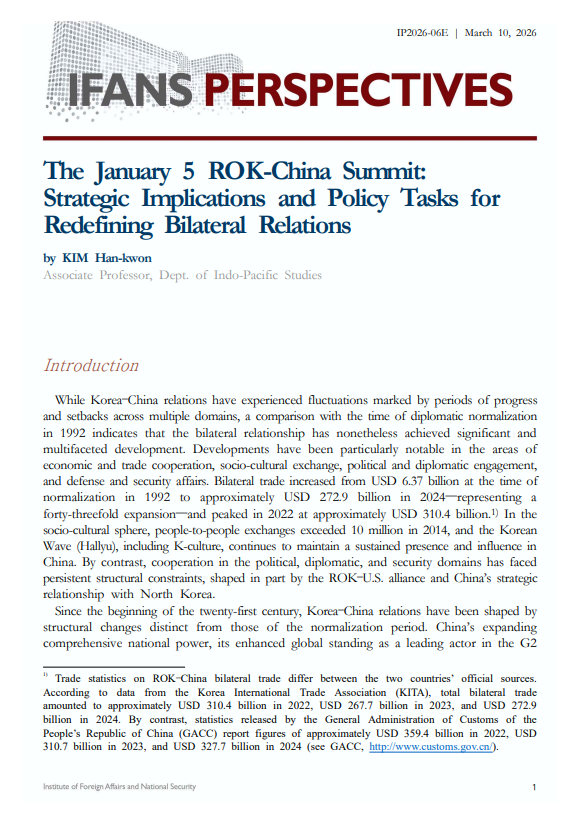
The January 5 ROK-China Summit: Strategic Implications and Policy Tasks for Redefining Bilateral Relation
(1월 5일 한중 정상회담: 양국 관계 재정립을 위한 전략적 함의와 정책 과제)While Korea-China relations have experienced fluctuations marked by periods of progress and setbacks across multiple domains, a comparison with the time of diplomatic normalization in 1992 indicates that the bilateral relationship has nonetheless achieved significant and multifaceted development. Developments have been particularly notable in the areas of economic and trade cooperation, socio-cultural exchange, political and diplomatic engagement, and defense and security affairs. Bilateral trade increased from USD 6.37 billion at the time of normalization in 1992 to approximately USD 272.9 billion in 2024―representing a forty-threefold expansion—and peaked in 2022 at approximately USD 310.4 billion. In the socio-cultural sphere, people-to-people exchanges exceeded 10 million in 2014, and the Korean Wave (Hallyu), including K-culture, continues to maintain a sustained presence and influence in China. By contrast, cooperation in the political, diplomatic, and security domains has faced persistent structural constraints, shaped in part by the ROK-U.S. alliance and China’s strategic relationship with North Korea.
Since the beginning of the twenty-first century, Korea-China relations have been shaped by structural changes distinct from those of the normalization period. China's expanding comprehensive national power, its enhanced global standing as a leading actor in the G2 framework, and the intensification of U.S.-China strategic competition have generated structural challenges in major sectors of bilateral cooperation. Following a period of adjustment, relations entered a phase of conflict after 2016 and have now reached a point requiring recalibration. Under these conditions, South Korea must recognize the gap in national power and international status and develop both short-and long-term policy strategies to address or manage structural challenges within the bilateral relationship.
Against this backdrop, this study analyzes the outcomes of President Lee Jae-myung’s state visit to China (January 4~7, 2026), undertaken as a reciprocal visit following President Xi Jinping’s trip to the Republic of Korea on the occasion of the 2025 Gyeongju APEC Summit, as well as the January 5 Korea-China summit meeting. The analysis focuses on the significance of these diplomatic engagements within the historical evolution of bilateral relations and the current phase of strategic recalibration. It then evaluates the implications of President Lee’s visit, assesses the future trajectory of Korea-China relations, and identifies key pending issues and structural challenges that must be addressed or managed in the process of redefining the bilateral relationship. Finally, it presents short-and long-term policy recommendations that South Korea should pursue at this critical juncture in the redefinition of Korea-China relations.
(출처: 외교안보연구소)
목차
1. Introduction
2. Historical Background of Korea-China Relations and the Significance of President Lee Jae-myung's Visit to China
3. An Assessment of President Lee Jae-myung's Visit to China and Policy Recommendations for Korea
해시태그
관련자료



AI 요약·번역·분석 서비스
AI를 활용한 보고서 요약·번역과 실시간 질의응답 서비스입니다.
The January 5 ROK-China Summit: Strategic Implications and Policy Tasks for Redefining Bilateral Relation
(1월 5일 한중 정상회담: 양국 관계 재정립을 위한 전략적 함의와 정책 과제)
국가전략포털에서 실시간 AI 질의응답 서비스를 시작합니다. 4가지 유형의 요약과 번역을 이용해보시고, 보고서에 대해 추가로 알고 싶은 내용이 있으면 채팅창을 통해 자유롭게 AI에게 물어볼 수 있습니다.
※ 제공하는 정보는 참고용이며, 정확한 사실 확인이 필요할 수 있습니다. 민감한 개인정보는 입력하지 마십시오.