
- 주제별 국가전략 목록으로 이동
- 주제별 국가전략
- 전체
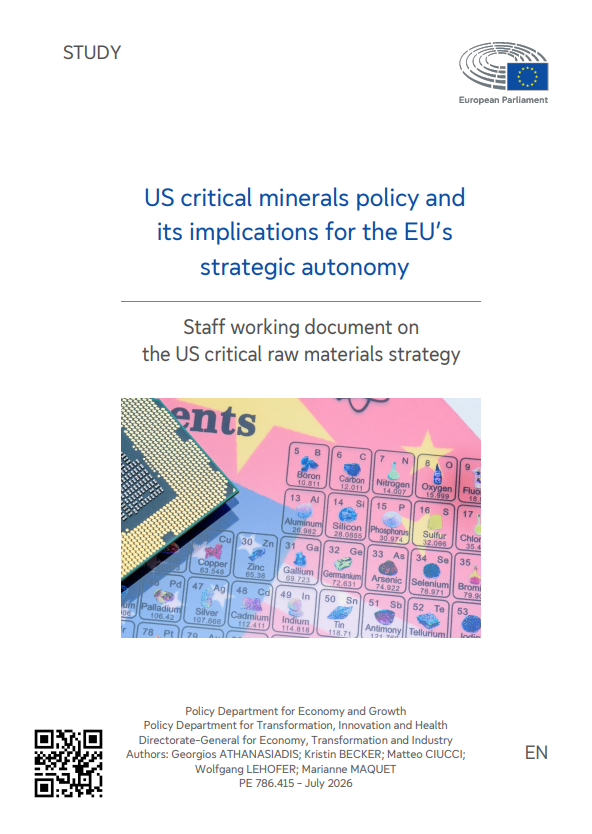
US critical minerals policy and its implications for the EU strategic autonomy
(미국의 핵심광물 정책과 그것이 유럽연합(EU)의 전략적 자율성에 미치는 영향)목차
LIST OF ABBREVIATIONS 9
LIST OF BOXES 11
LIST OF FIGURES 11
LIST OF TABLES 11
EXECUTIVE SUMMARY 12
1. INTRODUCTION 16
1.1. Strategic context 16
1.1.1. Not a simple commodity 16
1.1.2. A volatile geopolitical landscape 16
1.1.3. Policymakers are doubling down on critical materials 18
1.2. Objectives and methodological approach 19
1.2.1. Objectives 19
1.2.2. Methodology 19
1.3. Key differences between the EU and the US terminology and scope 20
2. VALUE-CHAIN ANALYTICAL FRAMEWORK FOR CRITICAL RAW MATERIALS 22
2.1. Upstream extraction 24
2.2. Midstream processing 25
2.3. Downstream manufacturing 26
2.4. Recycling and circularity as a cross-cutting dimension 27
2.5. Dynamic criticality: why supply-chain analysis must be continuous 29
2.6. Sectoral applications: defence, space, semiconductors, transport and clean energy 30
2.6.1. Defence and national security 30
2.6.2. Space industries 30
2.6.3. Semiconductors and advanced electronics 31
2.6.4. Transport and electromobility 31
2.6.5. Clean-energy and power systems 31
2.7. Structural conclusions: the midstream gap as the master vulnerability 32
3. US RAW MATERIAL STRATEGY 33
3.1. Understanding the US governance architecture of critical raw materials 33
3.1.1. Strategic direction and coordination 34
3.1.2. Definition and mineral intelligence 34
3.1.3. Industrial development and technology 34
3.1.4. Defence and security 35
3.1.5. Fiscal incentives, financing and investments 35
3.1.6. External engagement 36
3.1.7. Legislative authority and oversight 36
3.2. Building the US critical minerals policy (2017–2024) 37
3.2.1. Phase 1: strategic recognition and framework-building (2017–2020) 38
3.2.2. Phase 2: integration into supply-chain resilience and industrial policy (2021–2022) 39
3.2.3. Phase 3: implementation, coordination and system constraints (2023–2024) 39
3.3. US critical minerals policy under the second Trump administration (2025–2026) 40
3.3.1. Executive coordination and centralisation 41
3.3.2. Congressional reinforcement since 2025 42
3.4. External dimension and diplomatic-security initiatives 44
3.4.1. From MSP to FORGE 44
3.4.2. Project Vault, financing and the new strategic reserve logic 45
3.4.3. Bilateral agreements: structure and rationale 47
3.4.4. Pax Silica 49
4. COMPARATIVE POLICY-DESIGN ANALYSIS: THE UNITED STATES VS THE EU 52
4.1. Funding: contrasting scale and instruments 52
4.2. Stockpiling 55
4.2.1. Key differences 55
4.2.2. Strategic considerations 57
4.2.3. The operationalisation of an EU stockpiling framework 57
4.2.4. Monitoring and oversight 57
4.2.5. Systemic readiness 58
4.2.6. Company preparedness 58
4.2.7. Coordination 59
4.2.8. Crisis management 59
4.2.9. CRM stockpiling pilot 59
4.2.10. Stockpiles in EU Member States 59
4.3. Price floors and other price-support instruments 60
4.3.1. US: price floors supported by trade measures 60
4.3.2. Tariffs for the implementation of price floors 60
4.3.3. If you want to go far, go together 61
4.3.4. EU: focus on price stabilisation 61
4.3.5. Joint purchasing 61
4.3.6. Stockpiling 62
4.3.7. Lack of revenue-stabilisation tools 62
4.3.8. The "Middle Way": Contracts for Difference mechanisms 63
4.3.9. No one-size-fits-all solution 64
5. PARLIAMENTARY COMMITTEES 66
5.1. Parliament position 66
5.2. Relevance for IMCO 66
5.2.1. Single market integrity and the Foreign Subsidies Regulation 67
5.2.2. Intra-EU investment distortion from asymmetric national CRM support 68
5.2.3. Public procurement as a demand-side CRM instrument 69
5.2.4. US tax credit architecture and single market fragmentation risk 69
5.2.5. Single market access conditionalities for CRM 70
5.2.6. Internal Market Emergency and Resilience Act 71
5.3. Relevance for ITRE 72
5.3.1. De-risking and financing CRM projects 72
5.3.2 Sustaining competitiveness despite the "stability premium" 73
5.3.3. Leveraging ESG, defence and decarbonisation to strengthen CRM value chains 75
5.3.4. Importance of identifying the entire supply chain of CRMs 76
5.3.5. The EU's potential across the value chain 77
5.3.6. Recycling and circular economy-based supply chains 82
5.3.7. CRM list: where to start? 84
5.3.8. Fit-for-purpose stockpiling 85
6. CONCLUSION 89
6.1. US critical minerals strategy: from framework-building to direct market intervention 89
6.2. US institutional architecture: distributed mandates, centralised coordination 90
6.3. Value-chain assessment: the criticality of the midstream gap 90
6.4. Comparison of US and EU governance models 91
6.5. Market access, industrial policy and security: conditioned openness and critical minerals agreements 91
6.6. Cross-cutting finding I: China as structural third actor 92
6.7. Cross-cutting finding II: the speed mismatch between supply-chain leverage and industrial policy response 93
6.8. Cross-cutting finding III: closing the financing, institutional and governance gaps 93
KEY REFERENCES 95
해시태그
관련자료



AI 요약·번역·분석 서비스
AI를 활용한 보고서 요약·번역과 실시간 질의응답 서비스입니다.
US critical minerals policy and its implications for the EU strategic autonomy
(미국의 핵심광물 정책과 그것이 유럽연합(EU)의 전략적 자율성에 미치는 영향)
국가전략포털에서 실시간 AI 질의응답 서비스를 시작합니다. 4가지 유형의 요약과 번역을 이용해보시고, 보고서에 대해 추가로 알고 싶은 내용이 있으면 채팅창을 통해 자유롭게 AI에게 물어볼 수 있습니다.
※ 제공하는 정보는 참고용이며, 정확한 사실 확인이 필요할 수 있습니다. 민감한 개인정보는 입력하지 마십시오.