
- 주제별 국가전략 목록으로 이동
- 주제별 국가전략
- 전체
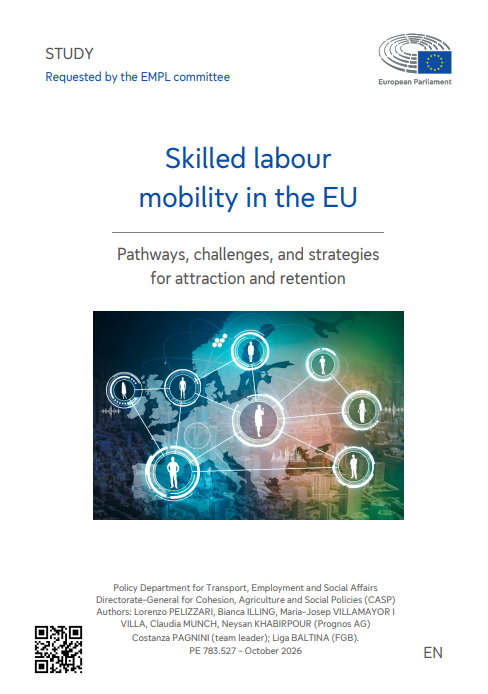
Skilled labour mobility in the EU: pathways, challenges, and strategies for attraction and retention
(EU 숙련인력 이동: 유치·유지를 위한 경로, 과제 및 전략)목차
CONTENTS 3
LIST OF ABBREVIATIONS 5
LIST OF BOXES 10
LIST OF FIGURES 10
LIST OF TABLES 10
EXECUTIVE SUMMARY 12
INTRODUCTION 15
1. SKILLED LABOUR MOBILITY IN THE EUROPEAN UNION: STRATEGIES TO
PROMOTE SKILLED EMPLOYMENT AND TERRITORIAL COHESION 16
1.1. Labour shortages: a sectoral and occupational map 16
1.1.1. Scale and trajectory 16
1.1.2. Persistent shortages in strategic sectors 20
1.1.3. Occupational shortages and skill levels most affected 24
1.2. Labour mobility: scale, flows, and occupational profile 26
1.2.1. The scale and forms of labour mobility 26
1.2.2. Main countries of origin and destination 30
1.2.3. Occupational and skill profiles of movers 34
1.3. Investment in training: developing the skills Europe needs 36
1.3.1. Adult training: participation, unequal access and investment 36
1.3.2. Public investment in training and the EU policy response 38
1.3.3. What investment in training can achieve 42
1.4. Regional talent pressures taxonomy (NUTS-3) 42
1.5. Policies and Best Practices for Place-Based Talent Development 47
1.5.1. Attraction-oriented instruments 48
1.5.2. Retention-oriented instruments 50
1.5.3. Develop own talent 52
1.5.4. The transversal enabler: multi-level governance 53
2. POSTING OF THIRD-COUNTRY NATIONALS 56
2.1. EU legal landscape and regulatory framework 57
2.1.1. Legislative mapping 58
2.1.2. CJEU case law 62
2.1.3. Identification and mapping of grey zones 64
2.2. Sectoral and occupational mapping of TCN posting 67
2.2.1. Sectoral Concentration 68
2.2.2. Worker categories 69
2.2.3. Geographical patterns 71
2.2.4. Subcontracting chains and vulnerability 74
2.2.5. Data limitations and knowledge gaps 75
2.3. Comparative national implementation and enforcement 75
2.3.1. How national authorities interpret “genuine posting” 75
2.3.2. A1 certificate contestability 76
2.3.3. Migration rules and host-state checks 77
2.3.4. Sanctions and enforcement mechanisms 77
2.4. Best practice case studies 80
2.4.1. Worker protection and access to remedy 80
2.4.2. Data-driven transparency of posting 87
2.4.3. Cross-border administrative cooperation 90
3. CONCLUSIONS AND POLICY RECOMMENDATIONS 97
3.1. Conclusions 97
3.1.1. Skilled labour mobility, regional disparities and territorial cohesion 97
3.1.2. Posting of third-country nationals 99
3.1.3. What the two parts of the study have in common 102
3.2. Policy recommendations 102
3.2.1. Skilled labour mobility, regional disparities and territorial cohesion 102
3.2.2. Posting of third-country nationals 104
3.2.3. The role of the European Parliament 106
REFERENCES 108
해시태그
관련자료



AI 요약·번역·분석 서비스
AI를 활용한 보고서 요약·번역과 실시간 질의응답 서비스입니다.
Skilled labour mobility in the EU: pathways, challenges, and strategies for attraction and retention
(EU 숙련인력 이동: 유치·유지를 위한 경로, 과제 및 전략)
국가전략포털에서 실시간 AI 질의응답 서비스를 시작합니다. 4가지 유형의 요약과 번역을 이용해보시고, 보고서에 대해 추가로 알고 싶은 내용이 있으면 채팅창을 통해 자유롭게 AI에게 물어볼 수 있습니다.
※ 제공하는 정보는 참고용이며, 정확한 사실 확인이 필요할 수 있습니다. 민감한 개인정보는 입력하지 마십시오.