
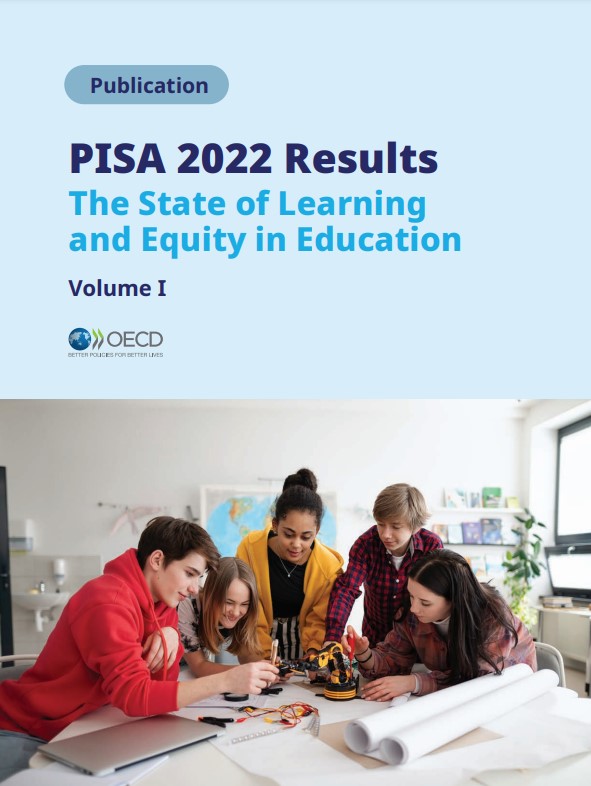
* OECD는 만 15세 학생(중3~고1)의 학업 성취 추이를 국제적으로 비교하기 위해 3년 주기로 평가를 시행하고 있음
□ 한국 학생들은 OECD 회원국 중 수학 527점으로 1∼2위, 읽기 515점으로 1∼7위, 과학 528점으로 2∼5위로 높은 성취를 나타냈고 전체 81개국 중에서도 수학 3∼7위, 읽기 2∼12위, 과학 2∼9위로 높은 순위를 기록함. 코로나19를 겪으면서 OECD 국가들의 학업 성취도 점수는 전 영역에서 하락했지만, 한국은 점수가 소폭 상승함
□ 영국 시사주간지 이코노미스트 등 외신들은 선진국 전반의 학업성취도가 떨어진 가운데 한국·일본·싱가포르·대만 등 극소수 국가들은 오히려 학업성취도가 개선된 이유에 대해 '팬데믹에 대한 대응의 차이' 때문이라고 설명함. 학교 폐쇄에 따른 수업 차질 기간이 상대적으로 짧은 국가들이 대체로 성적이 좋았고, 원격 수업의 품질 차이도 학업성취도 격차를 만든 것으로 보인다고 분석함
□ 다만, 학생 간 학력 격차를 보여주는 ‘학교 내 수학 점수 분산 비율’은 한국이 98.1%로 OECD 평균(68.3%)보다 1.4배 높았음. 수학에서 하위 성취수준을 기록한 학생 비율은 2018년 15%에서 2022년 16.2%로 1.2%포인트, 상위 성취수준 비율은 21.4%에서 22.9%로 1.5%포인트 각각 늘면서 중위권이 줄어들고 상위권이 늘어나는 등 학력격차가 커짐
[출처]
왜 한국·일본·싱가포르 학생들 성적은 쑥…외신도 놀랐다 (2023.12.06.) / 연합뉴스
한국 학생 수학·읽기 OECD 최상위권…학습 격차도 최고 수준 (2023.12.05.) / 중앙일보
[참고자료]
「PISA 2022」 결과 발표 별첨 자료 (2023.12.05.) / 한국교육과정평가원
목차
Preface 3
Foreword 5
Acknowledgements 7
Reader’s Guide 16
Executive Summary 26
What is PISA? 38
OECD’s Programme for International Student Assessment (PISA) 38
What is unique about PISA? 38
Which countries and economies participate in PISA? 38
Key features of PISA 2022 40
Where can you find the results? 42
1 The state of learning and equity in education in 2022 43
PISA 2022: an unprecedented performance drop 44
The long view 45
Gender and immigrant background 46
Education systems that combine strong performance with equity in education 46
Student performance and equity in education as covered in this volume 47
2 How did countries perform in PISA? 49
Average performance in mathematics, reading and science 50
Variation in performance within and between countries and economies 60
Ranking countries’ and economies’ performance in PISA 64
3 What can students do in mathematics, reading and science? 88
What students can do in mathematics 89
What students can do in reading 96
What students can do in science 101
4 Equity in education in PISA 2022 109
Equal opportunity by student socio-economic status 111
Equal opportunity in terms of student gender 122
Equal opportunity in terms of education system 135
Inclusive education 143
From fairness and inclusion to equity in education 145
5 Changes in performance and equity in education between 2018 and 2022 152
Three benchmarks for interpreting performance changes over time 154
Changes in performance between 2018 and 2022 154
Changes in equity between 2018 and 2022 164
6 Long-term trends in performance and equity in education 181
Changes in performance throughout countries’ participation in PISA 182
Trends in mean performance 183
Trends among high- and low-achieving students 189
Changes in the proportion of 15-year-old students at different levels of proficiency 192
Average 10-year trend in performance, taking into account changes in enrolment rates 194
Changes in equity in education over the last decade 198
7 Immigrant background and student performance 205
Students with an immigrant background in PISA 207
Disparities in student performance by immigrant background 214
Trends in disparities in performance by immigrant background 218
8 From data to insights 224
Examine why student performance declined so sharply 225
Provide all students with opportunities to fulfil their potential regardless of their backgrounds, and tailor policies to education systems’ particular contexts 226
Study resilient systems where learning, equity and well-being were maintained and promoted despite pandemic-related disruptions 227
해시태그
관련자료


AI 요약·번역·분석 서비스
AI를 활용한 보고서 요약·번역과 실시간 질의응답 서비스입니다.
PISA 2022 Results, Volume 1 : The State of Learning and Equity in Education
(국제 학업성취도 평가 2022 결과 vol.1 : 학습 및 형평성 현황)
국가전략포털에서 실시간 AI 질의응답 서비스를 시작합니다. 4가지 유형의 요약과 번역을 이용해보시고, 보고서에 대해 추가로 알고 싶은 내용이 있으면 채팅창을 통해 자유롭게 AI에게 물어볼 수 있습니다.
※ 제공하는 정보는 참고용이며, 정확한 사실 확인이 필요할 수 있습니다. 민감한 개인정보는 입력하지 마십시오.