



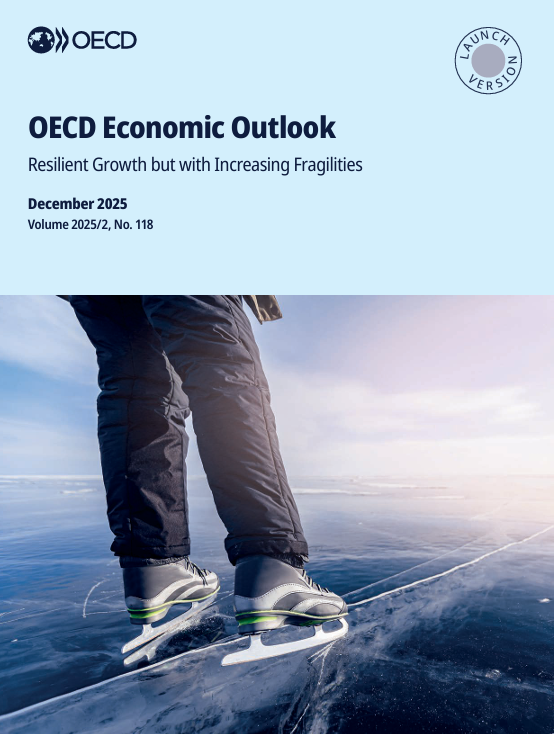
□ OECD, 경제전망 발표…세계경제는 견조하나 구조적 취약성 지속
ㅇ OECD는 무역장벽 강화와 정책 불확실성에도 불구하고 올해 세계경제가 예상보다 높은 회복력을 보였다고 평가함
ㅇ 다만 부채 증가, 자산가격 조정 위험, 인플레이션 압력 등 구조적 취약성이 여전히 상존한다고 지적함
ㅇ 세계경제 성장률은 ’25년 3.2%, ’26년 2.9%, ’27년 3.1%로 완만한 흐름을 이어갈 전망임
-미국은 고용 부진과 관세 인상에 따른 물가 전가로 성장세가 둔화될 전망임
-일본은 내수 회복에도 순수출 감소가 제약요인으로 작용하여 성장률이 둔화될 전망임
- 유로지역은 ’26년 둔화 이후 ’27년 내수·무역 회복으로 완만히 반등할 전망임
- 중국은 부동산 부문 부진과 조기선적 효과 소멸 등으로 성장률이 낮아질 전망임
□ 세계경제의 하방·상방 요인 공존…정책 불확실성 완화와 규범 기반 무역환경 필요
ㅇ 하방 요인으로는 ➊무역정책의 추가 변화, ➋인플레 압력 재부상, ➌자산가격 급락에 따른 금융시스템 위험, ➍재정건전성 악화 등을 지적함
ㅇ 상방 요인으로는 ➊무역장벽 완화, ➋지정학적 불확실성 감소, ➌AI 투자 확대로 인한 생산성 상승 가능성을 제시함
ㅇ OECD는 무역정책의 예측 가능성과 글로벌 협력 복원을 강조하며 통화정책은 물가 위험에 대한 경계 강화를 주문함
-재정 측면에서는 공공부채 증가 속에서 충격 대응 여력 확보를 위한 재정규율이 필요하다고 제언함
□ 한국경제, ’25년 1.0% 이후 ’26~’27년 2.1% 성장 전망…민간소비·수출 회복이 견인
ㅇ 한국은 ’25년 일시적 둔화(1.0%) 이후 완화적 통화정책, 소비쿠폰 등 재정정책, 실질임금 상승 효과로 ’26년과 ’27년에 2.1% 성장할 것으로 전망됨
ㅇ 민간소비는 정책 지원과 노동시장 회복에 힘입어 개선되고 수출은 글로벌 회복 흐름 속에서 성장 기여도가 확대될 전망임
ㅇ 소비자물가 상승률은 ’25년 2.0%, ’26년 1.8%, ’27년 2.0%로 목표 수준에서 안정될 것으로 예상됨
-물가 목표치(2%) 부합 범위 내 유지로 통화정책의 점진적 완화 여지가 존재함
-정책 조정 과정에서 관세 인상 영향은 제한적이나 글로벌 공급망 구조 변화는 불확실성을 높이는 요인으로 지적됨
[출처] [보도참고] 경제협력개발기구, 12월 경제전망 발표 (2025.12.02.) / 기획재정부 보도자료
목차
Title page 1
Contents 4
Acknowledgements 8
Editorial: Resilient growth but with increasing fragilities 9
1. General assessment of the macroeconomic situation 11
Introduction 11
Recent Developments 13
Projections 28
Risks 33
Policies 45
References 61
Annex 1.A. Policy and other assumptions underlying the projections 65
2. Time for a Regulatory Reset? 66
Summary 66
The productivity slowdown has been underpinned by a decline in economic dynamism 67
The case for a regulatory reset 68
Executing the regulatory reset: a recipe to restore productivity and dynamism prospects 78
References 95
3. Developments in individual OECD and selected non-member economies 103
Argentina 104
Australia 107
Austria 110
Belgium 113
Brazil 116
Bulgaria 120
Canada 123
Chile 127
China 130
Colombia 134
Costa Rica 137
Croatia 140
Czechia 143
Denmark 146
Estonia 149
Euro area 152
Finland 156
France 159
Germany 163
Greece 167
Hungary 170
Iceland 173
India 176
Indonesia 180
Ireland 184
Israel 187
Italy 190
Japan 194
Korea 198
Latvia 201
Lithuania 204
Luxembourg 207
Malaysia 210
Mexico 213
Morocco 216
Netherlands 219
New Zealand 222
Norway 225
Peru 228
Philippines 231
Poland 234
Portugal 237
Romania 240
Slovak Republic 243
Slovenia 246
South Africa 249
Spain 252
Sweden 255
Switzerland 258
Thailand 261
Türkiye 264
Ukraine 267
United Kingdom 270
United States 274
Viet Nam 278
Tables 7
Table 1.1. Global GDP growth is projected to moderate next year and recover only slowly 13
Figures 5
Figure 1.1. Global growth has remained resilient 14
Figure 1.2. Trade growth has been resilient 15
Figure 1.3. Strong tech-related demand is supporting trade, particularly in Asia 15
Figure 1.4. Strong ICT investment has supported economic growth 16
Figure 1.5. Global industrial production and trade are being supported by activity in the ICT sector 17
Figure 1.6. Consumer sentiment remains subdued and some indicators of economic activity have slowed 18
Figure 1.7. The impact of US tariffs is increasingly being felt 19
Figure 1.8. Estimated US effective tariff rates 21
Figure 1.9. USMCA compliance has limited effective tariff rates increases on US imports from Canada and Mexico 22
Figure 1.10. Different shares of duty-free trade with the United States result in wide variation in effective sectoral tariff rates 22
Figure 1.11. Labour demand has slowed and unemployment rates have generally drifted higher 23
Figure 1.12. Labour cost growth remains elevated and real wages have risen in most economies 24
Figure 1.13. Disinflation has levelled off in some economies partly due to higher goods inflation 25
Figure 1.14. Underlying inflation and short-term inflation expectations have risen in some economies 26
Figure 1.15. Elevated equity valuations are supported by the higher expected earnings of technology companies 27
Figure 1.16. Sustained debt issuance and declining bank lending rates 28
Figure 1.17. Global growth is projected to weaken before recovering gradually 29
Figure 1.18. Trade patterns are evolving with emerging markets becoming a key driver of growth 31
Figure 1.19. Inflation is projected to move towards central bank targets 32
Figure 1.20. Global production and demand for rare earths is highly dependent on China 34
Figure 1.21. Tariffs on pharmaceutical products or semiconductors would hit output in many countries 34
Figure 1.22. Services trade needs to be supported to raise growth 35
Figure 1.23. Trade policy uncertainty has risen to historically high levels 36
Figure 1.24. Trade policy uncertainty shocks inhibit trade growth 37
Figure 1.25. Strong growth of listed AI technology firms has had spillovers across the economy 39
Figure 1.26. The rise of NBFIs and banks’ increasing exposure to the sector 40
Figure 1.27. The market value of crypto-assets has risen sharply and returns are volatile 42
Figure 1.28. Stablecoins transactions and holdings of US Treasury bills are rising 42
Figure 1.29. Emerging-market economies have benefitted from resilient capital flows but face higher US tariffs 44
Figure 1.30. Real short-term interest rates have eased 46
Figure 1.31. Policy rate reductions are projected to end next year in many advanced economies 47
Figure 1.32. Real policy rates are projected to converge to neutral level ranges 48
Figure 1.33. Primary deficits, net interest payments and change in public debt ratios 50
Figure 1.34. Military spending is increasing at different rates across countries 51
Figure 1.35. Net purchases of sovereign bonds by investor type in selected advanced economies 54
Figure 1.36. Lower policy rates are projected in many emerging-market economies as inflation converges to targets 55
Figure 1.37. Fiscal balances are expected to improve in most emerging-market economies 56
Figure 1.38. Productivity growth and economic dynamism have slowed 57
Figure 1.39. Simplifying regulations is a reform priority in many economies 59
Figure 1.40. There is room to improve the regulatory framework for trade 60
Figure 2.1. Productivity and economic dynamism have slowed in the last 20 years 67
Figure 2.2. The share of labour costs devoted to regulatory tasks has increased in many US states and territories 70
Figure 2.3. The share of employment devoted to regulatory tasks has risen in selected OECD countries 71
Figure 2.4. The costs of regulation in Europe and Australia are similar to the United States 73
Figure 2.5. Rising regulatory compliance costs is associated with lower productivity and business dynamism in the long run 74
Figure 2.6. Rising regulatory compliance costs have suppressed productivity and business dynamism in the United States over the past decade 75
Figure 2.7. Increases in resources devoted to regulation gradually reduce productivity and business dynamism 77
Figure 2.8. A regulatory reset to restore productivity and dynamism prospects 78
Figure 2.9. While regulatory impact assessments are becoming more common, ex post evaluation tools remain underutilised 79
Figure 2.10. Most countries still lack comprehensive legislation on lobbying activities and fail to impose essential disclosure requirements 82
Figure 2.11. Deregulation has recently slowed, yet large regulatory barriers remain in services sectors 84
Figure 2.12. Labour productivity gains from easing regulations in retail and professional services would be significant 86
Figure 2.13. Insolvency regimes are more dynamism-friendly in some countries than others 87
Figure 2.14. The extent of labour protection varies across countries 88
Figure 2.15. Digital investment has outpaced other investment types across the OECD, most strongly in the United States 91
Boxes 7
Box 1.1. Recent developments in ICT investment 16
Box 1.2. US tariff rates: in law and in effect 19
Box 1.3. The impact of policy uncertainty on trade growth 35
Box 1.4. Growing linkages between stablecoins and traditional finance: implications for financial stability 41
Box 2.1. Estimating the resources dedicated to servicing regulatory compliance 71
Box 2.2. The short-run impact of regulations on productivity and business dynamism in the United States 76
Box 2.3. Pro-competitive product market regulations support economic growth 83
Box 2.4. Regulatory barriers in market services are extensive 85
Box 2.5. Five key regulatory barriers to solar, wind, and pumped hydro storage 93