
- 주제별 국가전략 목록으로 이동
- 주제별 국가전략
- 전체
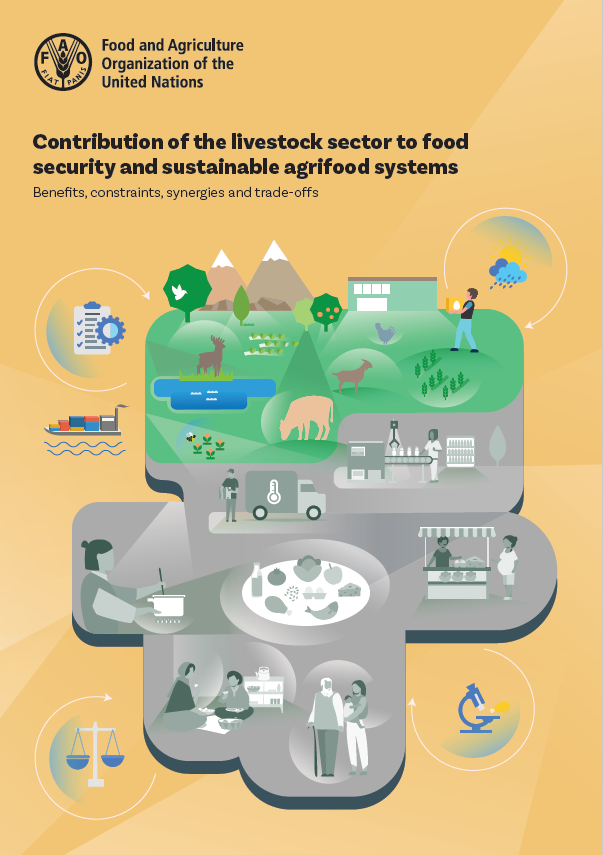
Contribution of the livestock sector to food security and sustainable agrifood systems: Benefits, constraints, synergies and trade-offs
(식량안보와 지속가능한 농식품체계에 대한 축산업의 기여: 편익, 제약요인, 시너지 및 상충관계)목차
Section A
INTRODUCTION 1
Key findings 2
Summary 2
1. Scope 3
2. Concepts, definitions and methods 4
3. Classification, distribution and services provided by livestock production systems 9
References 21
Section B
LIVESTOCK PRODUCTION SYSTEMS: CURRENT STATUS, TRENDS AND DRIVERS OF CHANGE 23
1. The contributions of livestock production systems to food security 27
2. Trends in livestock production systems 35
3. Drivers of change 48
3.1 Population growth and urbanization 49
3.2 Economic growth and changes in the labour sector 50
3.3 Land use and the environment 52
3.4 Animal health and animal diseases 52
3.5 Climate change 55
3.6 Technologies and innovation 56
3.7 Societal concerns: animal welfare 59
3.8 International trade and policies 61
4. Limitations, gaps and needs 62
References 63
Section C
CONTRIBUTION OF LIVESTOCK PRODUCTION SYSTEMS TO THE ECONOMIC SUSTAINABILITY OF AGRIFOOD SYSTEMS 71
Key findings 72
Summary 74
1. Contribution of the livestock sector to formal and informal economies 77
1.1 Contribution to gross domestic product 78
1.2 Contribution to income generation and poverty reduction 80
1.3 The livestock sector – a driver for building sustainable economies 81
1.4 Contribution to trade and economic growth 82
1.5 Contribution to tax revenue 84
1.6 Contribution to employment 85
1.7 Contribution to building resilient economies 85
1.8 Other contributions 86
2. Income generation 88
2.1 Livestock production as a source of livelihood 89
2.2 The role of livestock production in income inequality 98
2.3 The role of livestock in income diversification 98
2.4 Livestock and poverty 100
3. Household consumption and direct marketing 102
3.1 Household consumption and food security 102
3.2 Direct marketing 107
4. Contribution to territorial and national markets and to quality labels 111
4.1 Contribution to the provisioning of local and national markets 111
4.2 Contribution to quality and marketing labels 116
4.2.1 Geographical indications 120
4.2.2 Organic labelling 121
4.2.3 Animal welfare labelling 122
5. Feed and food loss and waste 123
5.1 Definition of food loss and waste 123
5.2 Sources of food loss and waste in livestock production systems 126
6. The role of cooperatives, associations and contract farming in production, processing and marketing 135
6.1 Contract farming, cooperatives and livestock production systems 136
6.2 Contract farming and cooperatives for livestock product processing and marketing 137
6.3 Drivers of contract farming and cooperatives 139
6.4 Effects of contract farming and cooperatives 140
6.5 Emerging challenges 143
7. Public and private investment in the livestock sector 144
7.1 Public investment in the livestock sector 144
7.2 Private investment in livestock production 150
7.3 Synergy between public and private investment 155
8. Limitations, gaps and needs 157
References 159
Section D
CONTRIBUTION OF LIVESTOCK PRODUCTION SYSTEMS TO THE SOCIAL SUSTAINABILITY OF AGRIFOOD SYSTEMS 191
Key findings 192
Summary 193
1. Human rights 196
1.1 Right to natural resources 196
1.1.1 Access to land 200
1.1.2 Access to water 201
1.2 Right to access social services 201
1.2.1 Right to education 202
1.2.2 Right to health 213
1.3 Right to no discrimination 215
2. Health and safety 217
2.1 Indicators of health and safety 217
2.2 Health and safety in specific livestock production systems 222
3. Working conditions 226
4. Employment 230
4.1 Work organization 231
4.2 Employment dynamics 235
4.3 Attractiveness of livestock farming professions 237
4.4 Migrants 239
4.5 Women 239
5. Importance of livestock for the social development of rural territories 242
5.1 Livestock as a driver of social capital at the landscape level 244
5.2 Local livestock products as a social marker of the territory 247
5.3 Valuing local culture and knowledge through livestock products and consumer preferences 248
6. Limitations, gaps and needs 256
References 257
Section E
CONTRIBUTION OF LIVESTOCK PRODUCTION SYSTEMS TO THE ENVIRONMENTAL SUSTAINABILITY OF AGRIFOOD SYSTEMS 289
Key findings 290
Summary 292
1. Land use 294
1.1 Livestock and food provisioning 296
1.2 Livestock and water use 299
1.3 Livestock and soil carbon 300
1.4 Livestock and biodiversity 301
1.5 Livestock and land use change 302
1.6 Wildfires in grass and shrublands 302
2. Biodiversity 303
2.1 Impacts of livestock production systems on the diversity of flora 304
2.2 Impact of livestock production systems on the diversity of fauna 305
2.3 Impacts of livestock production systems on livestock biodiversity 307
2.4 Impact of livestock production systems on soil biodiversity 309
2.5 Impacts of livestock production systems on microbiomes 312
3. Water 319
4. Soils 327
4.1 Evidence across regions 328
4.2 Effects of livestock production systems on carbon and elements in soils 330
4.3 Effects of livestock production systems on land degradation 333
4.4 Effects of livestock production systems on soil erosion 335
5. Air and atmosphere 338
5.1 Greenhouse gas emissions 338
5.2 Greenhouse gas emissions, carbon balance and carbon footprint of livestock production systems and products 344
5.3 Ammonia 350
6. Public health issues 356
6.1 Livestock production systems and their impacts on public health 358
6.2 Case studies 363
6.2.1 Cysticercosis: a food- and water-borne zoonosis often found in extensive and free-range livestock production systems 363
6.2.2 Brucellosis: a bacterial zoonosis transmitted to people through direct contact and food-borne routes, endemic in peri-urban dairy production systems 364
6.2.3 Foot-and-mouth disease: a cause of far-reaching indirect public health impacts due to the effects of this disease and its control 365
6.2.4 Avian influenza virus: a focus of pandemic prevention 366
6.2.5 Antimicrobial use and antimicrobial resistance occur widely across livestock production systems and are of public health concern 368
6.3 Understanding public health risks and generating benefits through the One Health approach 372
7. Limitations, gaps and needs 374
References 376
Section F
THE RESILIENCE OF THE LIVESTOCK SECTOR AND ITS CONTRIBUTIONS TO THE CIRCULAR BIOECONOMY AND TO SUSTAINABLE AGRIFOOD SYSTEMS 417
Key findings 418
Summary 419
1. Resilience of the livestock sector 420
1.1 Resilience as a concept 420
1.2 Sources and impacts of perturbations on livestock production systems 424
1.3 Levers of resilience for livestock production systems 427
1.4 Resilience and long-term dynamics of livestock production systems 433
2. Contribution of the livestock sector to the circular bioeconomy 437
2.1 Using non-food competing resources for livestock feeding 440
2.2 Integrated livestock systems, livestock‑fish systems, and insect production 442
2.3 Valorizing by-products and wastes along the value chain 444
2.4 Food loss and waste 445
2.5 Biofuel by-products 445
2.6 Achieving circularity through manure management 447
2.7 Supplying human needs other than food 448
2.8 Challenges and gaps 449
3. Comparative contributions of livestock production systems to sustainable agrifood systems 453
4. Summary of the strengths, weaknesses and trade-offs of each livestock production system 457
5. Limitations, gaps and needs 464
References 465
Section G
POLICIES AND LEGAL FRAMEWORKS AFFECTING THE SUSTAINABILITY OF THE LIVESTOCK SECTOR 479
Key findings 480
Summary 480
1. International frameworks and agreements 482
1.1 The 2030 Agenda and the three Rio Conventions 486
1.2 International human rights instruments 497
1.3 Other international instruments relevant to the livestock sector 499
2. Regional regulations and perspectives 502
3. National legislation and policies 509
4. Gaps and needs 516
References 517
GLOSSARY 531
References 542
해시태그
관련자료


AI 요약·번역·분석 서비스
AI를 활용한 보고서 요약·번역과 실시간 질의응답 서비스입니다.
Contribution of the livestock sector to food security and sustainable agrifood systems: Benefits, constraints, synergies and trade-offs
(식량안보와 지속가능한 농식품체계에 대한 축산업의 기여: 편익, 제약요인, 시너지 및 상충관계)
국가전략포털에서 실시간 AI 질의응답 서비스를 시작합니다. 4가지 유형의 요약과 번역을 이용해보시고, 보고서에 대해 추가로 알고 싶은 내용이 있으면 채팅창을 통해 자유롭게 AI에게 물어볼 수 있습니다.
※ 제공하는 정보는 참고용이며, 정확한 사실 확인이 필요할 수 있습니다. 민감한 개인정보는 입력하지 마십시오.