
- 주제별 국가전략 목록으로 이동
- 주제별 국가전략
- 전체
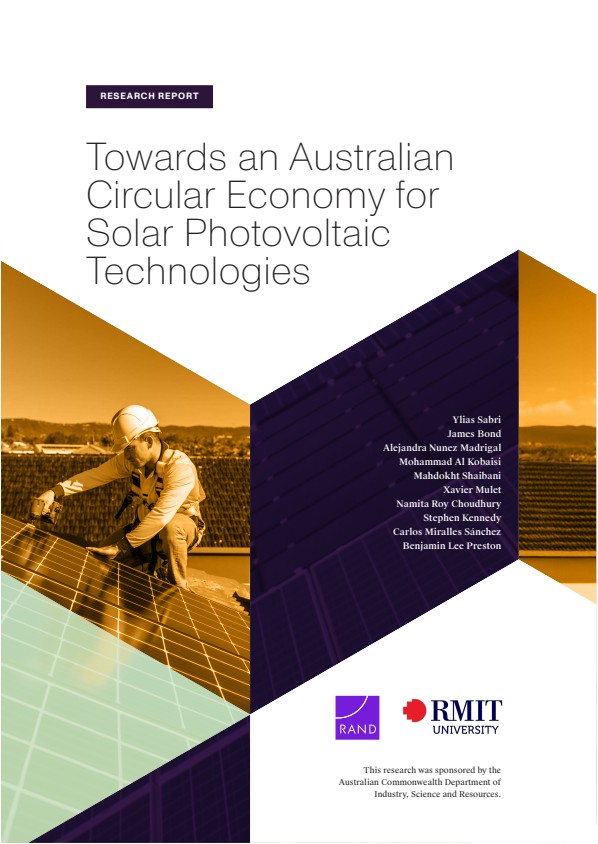
Towards an Australian Circular Economy for Solar Photovoltaic Technologies
(태양광 발전 기술을 위한 호주의 순환 경제 구축을 향하여)목차
Research Team and Affiliate Organisations iii
About This Report v
Summary vii
Figures and Tables xix
PART 1
Circular Economy Foundations and Context 1
CHAPTER 1
Introduction: Building a Circular Economy for Solar Photovoltaics in Australia 2
The Emerging Global Circular Economy 4
Economic Opportunity 7
Material Recovery 8
Objectives of This Report 9
Chapter 1 References 9
CHAPTER 2
Solar Photovoltaic Deployment and Future Projections in Australia 12
The State of Solar Deployment in Australia 14
Volume Forecasts: How Much Photovoltaic Waste Will Australia Have to Deal With and When? 16
Waste Diversion Potential 17
Conclusion 19
Chapter 2 References 19
CHAPTER 3
The State of the Solar Photovoltaic Circular Economy 22
Opportunities for Circularity 24
Circularity for Photovoltaic Installations: Certification Case Study 26
Global Examples of Circular Economies in the Photovoltaics Sector 26
Conclusion 28
Chapter 3 References 29
PART 2
Technical and Scientific Developments 31
CHAPTER 4
The Solar Photovoltaic Supply Chain: Manufacturing and Distribution 32
Understanding the Supply Chain 33
Global Production Capacity: Key Figures and Trends 34
Sources of Photovoltaic Materials 37
Projected Availability of Metals for Photovoltaics 38
End-of-Life Determination Methods 39
End-of-Life Feedstock Material Flows 42
Loss Quantification 42
Conclusion 44
Chapter 4 References 45
CHAPTER 5
Closing the Loop: Material Recovery for a Photovoltaic Circular Economy 48
Overview of Photovoltaic Recycling Processes in Australia 50
Material Recovery Breakthroughs 51
Emerging Recycling Technologies 52
Polymer Synthesis: Challenges for Use in Photovoltaic Panels 53
Depolymerisation of Polyethylene Terephthalate and the Recovery and Purification of Metals 54
Silicon Recovery and Purification 54
Fluoropolymer Backsheet Treatment and Recovery 55
Silver Recovery from End-of-Life Solar Panels 57
Automation Potential in Solar Panel Recycling 60
Material Complexity and Recovery Challenges 62
Analysis of the Pros and Cons of Recovery Methods 63
Chapter 5 References 65
CHAPTER 6
Logistics and Collection Systems for End-of-Life Solar Panels 70
Photovoltaic Collection and Assessment 72
Transport: The Carbon Footprint of Supply Chains from China to Australia 74
Infrastructure 76
Collection Network Requirements 78
Technology Deployment Needs 79
Regional Capacity Planning 80
Investment Requirements 81
Material Composition and Value Streams 82
Conclusion 84
Chapter 6 References 84
CHAPTER 7
Applications and Value of Recovered Materials from Solar Panels 88
Applications for Recovered Silicon 89
Applications for Recovered Silver 91
Applications for Recovered Copper 92
Applications for Recovered Aluminium 95
Conclusion 97
Chapter 7 References 98
PART 3
Policy, Infrastructure, Technology and Implementation 101
CHAPTER 8
Holistic Approaches: Social, Environmental and Business Considerations for a Photovoltaic Circular Economy 102
Social Considerations 103
Environmental Considerations 111
Commercial Considerations: Business-Model Development 116
Conclusion 122
Chapter 8 References 123
CHAPTER 9
A Techno-Economic Perspective on End-of-Life Photovoltaic Recycling 128
National Installation Trends and Waste Projection Basis 130
Baseline Techno-Economic Assessment for a 2,500-Tonne per Year Photovoltaic Recycling Facility 131
Case Study Focus: Victoria and Queensland 134
Comparative Assessment, Policy Implications and Final Recommendations 137
Final Recommendations for a National Deployment Strategy 139
Conclusion 140
Chapter 9 References 140
CHAPTER 10
Policy Framework: Gaps, Opportunities and Recommendations 142
The Role of Regulation 143
Examples of Global Best Practices in Circular Economy Policies 146
Regulation in the Australian Context 153
Future Policy Priorities for Australia’s Circular Economy 154
Conclusion 169
Chapter 10 References 170
CHAPTER 11
Implementation Roadmap: Pathways to a Circular Solar Economy 178
Planning Horizons for Implementing a Solar Photovoltaic Circular Economy 181
Research and Development 182
Policy and Regulatory Reform 182
Market Scaling 184
Logistics 185
Applications 186
Engagement 187
Cross-Cutting Issues 188
Conclusion 190
Chapter 11 References 190
APPENDIXES
A. Modelling Assumptions Used for the Techno-Economic Assessments 194
B. Methodology Used for the Techno-Economic Assessment 200
C. Operating Expenditure Breakdown Used in the Techno-Economic Assessment 204
D. Calculations Used in the Techno-Economic Assessment Scenarios 208
E. Photovoltaic Module Capacity to Mass Conversion Table for Recycling Applications 214
Abbreviations 217
Glossary 219
About the Authors 221
해시태그
관련자료



AI 요약·번역·분석 서비스
AI를 활용한 보고서 요약·번역과 실시간 질의응답 서비스입니다.
Towards an Australian Circular Economy for Solar Photovoltaic Technologies
(태양광 발전 기술을 위한 호주의 순환 경제 구축을 향하여)
국가전략포털에서 실시간 AI 질의응답 서비스를 시작합니다. 4가지 유형의 요약과 번역을 이용해보시고, 보고서에 대해 추가로 알고 싶은 내용이 있으면 채팅창을 통해 자유롭게 AI에게 물어볼 수 있습니다.
※ 제공하는 정보는 참고용이며, 정확한 사실 확인이 필요할 수 있습니다. 민감한 개인정보는 입력하지 마십시오.